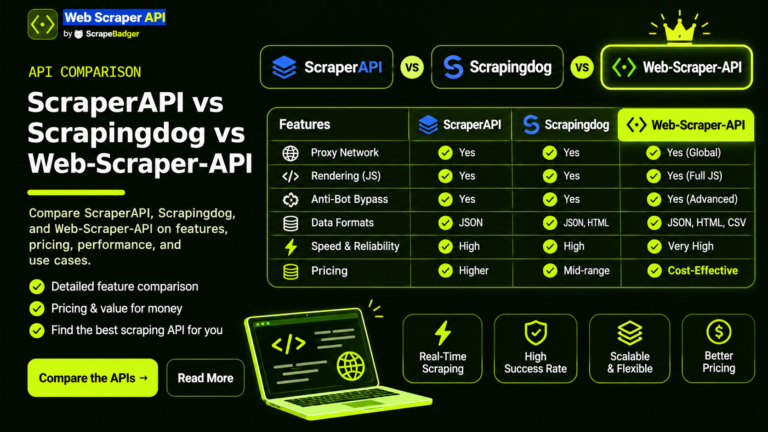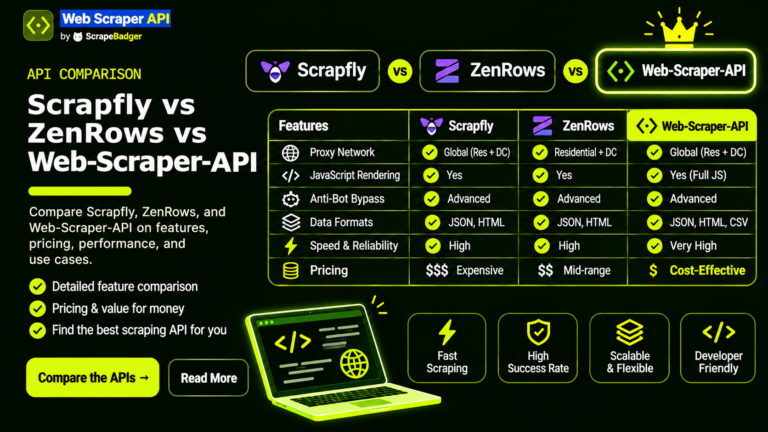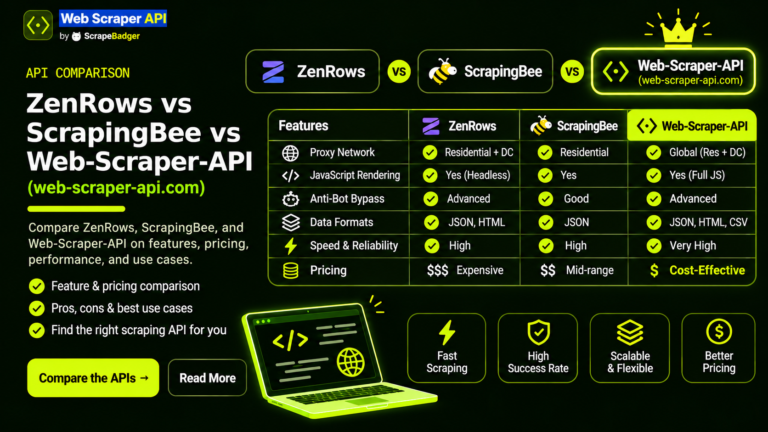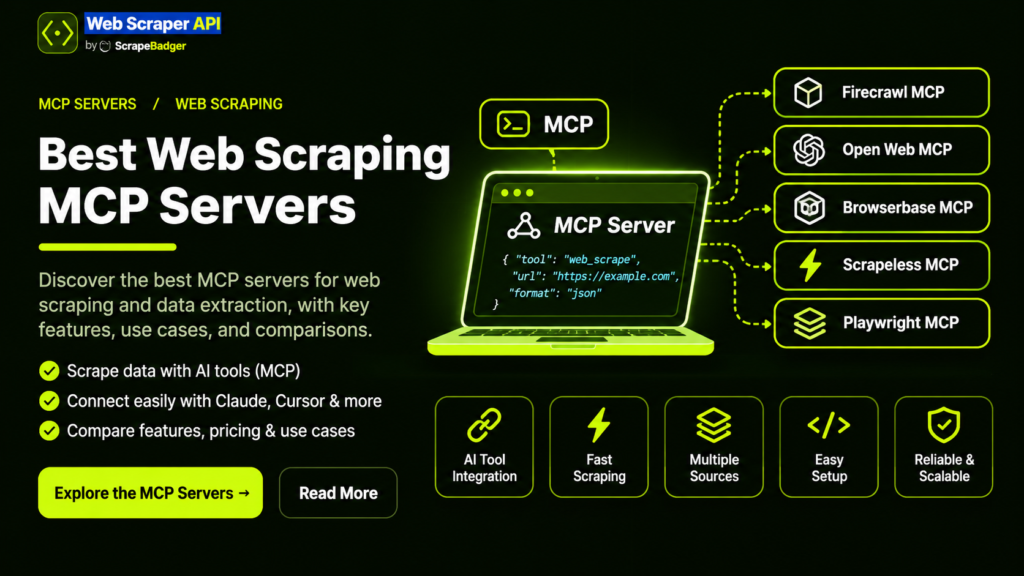
We Compared 9 Web Scraping MCP Servers: Which One to Use for Data Extraction (2026)
Your agent needs the live web. Somebody has already told you to "just add the Bright Data MCP". Fair enough, it's the default name in this space. But Bright Data rebuilt big parts of that server in October 2026, and most setup guides still describe the old one.
So we went looking for the best web scraping MCP servers and compared 9 of them. We judged them on what actually decides the pick. What can the tools reach, what does a page really cost, and how much of your agent's context does the tool list eat before it does anything?
Full disclosure: Web-Scraper-API is our product, a web scraping API with its own MCP server. It's in this list, with its cons
Quick answer
Pick Bright Data if you want 1,200+ first-party site scrapers and a free tier that renews every month. Pick Web-Scraper-API if you want typed data from X, Google, Amazon, Reddit and other big sites inside Claude or ChatGPT, through one OAuth connector. And if the job means logging in and clicking around, Playwright MCP does it for nothing.
| Server | Best for | Runs | Free allowance | Paid entry point | Tools by default | Schema tokens (approx.) |
|---|---|---|---|---|---|---|
| Bright Data | Prebuilt scrapers for big sites | Hosted + local | 5,000 requests/month | $1.50 per 1K results (PAYG) | 32 | ~5,500 |
| Web-Scraper-API | Typed site data in Claude and ChatGPT | Hosted | 1,000 credits, once | $0.150 per 1K credits (PAYG), Starter $49/mo | 344 | [PENDING] |
| Firecrawl | Crawling whole sites into markdown | Hosted + local | 1,000 credits/month | Hobby $19/mo, 5,000 credits | 28 | ~21,500 |
| Apify | Sites with a ready-made Actor | Hosted + local | $5 usage/month | Per Actor (Web Fetch from $1.00 per 1K) | A few, plus any Actor you add | not measured |
| ZenRows | Protected pages, failed calls free | Hosted + local | 5,000 credits/month | Build $19/mo, 45,000 credits | ~62 (hosted) | not measured |
| Zyte | A spend cap per agent | Hosted | $5 credit | PAYG by site tier | 34 | not measured |
| Decodo | Loading only the toolsets you need | Hosted + local | Free plan, up to 10K pages | $19/mo, 38K pages | 24 hosted, 33 local | not measured |
| Oxylabs | Google and Amazon targets | Hosted + local | $5 credit | Starter $30/mo | 10 or 6 (two servers) | not measured |
| Playwright MCP | Logged-in, click-through tasks | Self-hosted | Free | Free | 25 | ~4,500 |
The three kinds of web scraping MCP server
Before comparing anything, figure out which kind of server your job needs. Most commercial servers mix two of these.
Scraping-API servers wrap a hosted scraper. You send a URL, the vendor handles proxies, rendering and bot checks, and you get markdown or HTML back. Firecrawl, ZenRows, Decodo, Zyte, Oxylabs and Web-Scraper-API all work this way. Good for reading lots of pages.
Catalog servers run prebuilt scrapers for specific sites and return named fields: price, rating, follower count. Bright Data's 1,200+ scrapers, Apify's Actors and our dedicated endpoints sit here. When the site is big and well known, this beats parsing HTML every time.
Browser drivers hand the model a real browser it can click, type and scroll in. Playwright MCP is the pure version. Bright Data and ZenRows bolt browser tools onto their servers too. They're the only option for logins and multi-step forms. They're also slow, and every page snapshot lands in the context window.
Which one is yours? If you can name the site, start with a catalog. Can't name it? A scraping API. Someone has to log in? A browser.
How we compared them
Every server was judged on the same seven questions:
- What can the tools reach: plain pages, search, prebuilt site scrapers, a live browser?
- How does it handle blocking, as documented (proxies, geo, named anti-bot systems)?
- What does a page cost on the entry plan, and are failed calls billed?
- How much context does the tool list take, and can you trim it?
- Does the output come back as markdown, JSON, or a declared output schema?
- How do you connect: hosted or local, OAuth or a token in the URL?
- Is it official and recently released?
Methodology. We read each vendor's pricing page, docs and repo in November 2026. We ran tools/list against the three servers that ship as npm packages (firecrawl-mcp 3.36.0, @brightdata/mcp 4.2.0, @playwright/mcp 0.0.84) and counted the returned JSON with the cl100k tokenizer. That isn't Claude's own tokenizer, so read the counts as approximate. Hosted-only servers weren't measured. We ran no success-rate or speed benchmark, so this post doesn't claim one.
The 9 best web scraping MCP servers
1. Bright Data MCP: best for structured data from big sites
Bright Data's official server runs hosted at mcp.brightdata.com/mcp, with your API token in the URL, or locally through npx @brightdata/mcp. It exposes 32 tools by default. You get web search across Google, Bing and Yandex, markdown and HTML scraping, and 14 remote-browser tools. There are also two tools that collect ChatGPT and Perplexity answers, and six that find and run its prebuilt scrapers.
What changed in October 2026. This matters, because most guides that rank for "Bright Data MCP" are out of date:
- v3.0.0 (11 Oct): the 46 per-site
web_data_*tools were replaced by six catalog tools that search and run any of 1,200+ prebuilt scrapers. - v3.1.0 (15 Oct):
PRO_MODEwas removed. There's no Rapid vs Pro split anymore. Every tool is on by default. - v4.2.0 (1 Nov):
scrape_as_markdownandscrape_batchnow say "No JavaScript rendering" in their own tool descriptions. For pages that build their content in the browser, you'll want the browser tools.
So if a tutorial tells you to set PRO_MODE=true, it's describing a server that no longer exists.
Pricing. The free tier gives you 5,000 requests a month. It renews on the 1st, doesn't roll over, and is shared with any other Bright Data use on the account. Browser automation is included. After that it's pay-as-you-go: $1.50 per 1,000 results for search, scrape and extract, and $8 per GB for browser traffic. When the free requests run out, calls simply stop, unless you've deposited funds.
Context. The 32 tool definitions came to about 5,500 tokens in our count. You can cut that with groups: &groups=scrapers,browser on the hosted URL, or GROUPS locally. The groups are scrapers (6 tools), browser (14), geo (2) and advanced_scraping (5).
One nice detail. A "content gate" pauses and asks you before returning a scraped page that contains text telling your agent to change its MCP config. Prompt injection through scraped pages is a real risk, so that's worth having.
- Pros: a free tier that renews monthly; 1,200+ prebuilt scrapers maintained by Bright Data; tool groups to trim context.
- Cons: the token sits in the URL, so it ends up in config files and logs. The markdown scraper no longer renders JavaScript. Browser use is billed per GB, which is hard to predict per page. And the docs lag the repo: the tools page still lists
discover, which was removed on 18 Oct.
2. Web-Scraper-API: best for typed site data inside Claude and ChatGPT
Our server is hosted at mcp.scrapebadger.com/mcp (Web-Scraper-API is powered by ScrapeBadger). In Claude you add it under Settings, Connectors, Add custom connector, then sign in with OAuth. No key to paste. ChatGPT, Codex, Cursor, VS Code, Gemini CLI and Windsurf are documented too. Clients without OAuth use a Bearer header.
It exposes 344 tools across 31 products. Each one is a dedicated endpoint: Twitter/X, Instagram, Google, YouTube, TikTok, Amazon, eBay, Reddit, real estate sites, plus general web scraping. Every tool ships a typed output schema and read-only or destructive annotations. In practice, your agent knows the field names before it calls anything, so it doesn't have to guess at a blob of markdown.
Pricing. MCP calls use the same credits as the API, with no MCP surcharge. A web scrape costs 3 credits over HTTP, 7 with a browser, 13 with premium residential proxies, and 17 with both. Failed requests cost 0 credits. Pay-as-you-go runs $0.150 per 1,000 credits, and the Starter plan is $49 a month for 600,000 credits ($0.082 per 1,000). New accounts get 1,000 free credits with no card.
It also speaks the newest MCP spec (revision 2026-07-28) and still serves older clients.
- Pros: one OAuth connector for Claude and ChatGPT; typed output on every tool; failed calls are free.
- Cons: the 1,000 free credits are one-time, while Bright Data gives 5,000 requests every month. The catalog is narrower than Bright Data's 1,200+ scrapers. And 344 tools is a heavy list for any agent's context: [PENDING: token count, plus how to load only some products, if supported].
Try it on your own targets. 1,000 free credits, no card. Get your API key, then follow the Claude setup or the MCP guide.
3. Firecrawl: best for crawling whole sites into clean markdown
Firecrawl runs hosted at mcp.firecrawl.dev/v2/mcp with OAuth or a Bearer key, or locally with npx firecrawl-mcp. There's even a keyless endpoint with three tools, which is handy for a quick test. The npm package exposed 28 tools for us: scrape, map, search, crawl, extract, an agent tool and more.
Pricing is simple. You get 1,000 free credits a month, and Hobby is $19 for 5,000. A scrape costs 1 credit per page, JSON output adds 4, and search costs 2 credits per 10 results, plus the scrape cost of any result it fetches. Switching on its higher-grade proxy costs the same 1 credit.
The catch? Firecrawl's tool list was the heaviest we measured, about 21,500 tokens, because every one of its 28 tools carries an output schema. Also, a returned 403 or 404 page still costs a credit.
- Pros: flat per-page credits; great crawl and map tools; a keyless trial endpoint.
- Cons: the biggest context footprint here; error pages are billed.
Weighing Firecrawl specifically? See our Firecrawl alternatives breakdown.
4. Apify: best when a ready-made Actor exists for your site
Apify's server lives at mcp.apify.com (OAuth or Bearer), or locally via npx @apify/actors-mcp-server. By default you get a handful of tools: search the Actor store, read an Actor's details, call an Actor, plus a web browser and a web fetcher. The interesting part is that any Actor from its store can become a tool.
You don't pay for the server. You pay for the Actors it runs, at each Actor's own price. The free plan includes $5 of usage a month, and Starter is $19. The Web Fetch Actor starts at $1.00 per 1,000 fetches and charges nothing for failures.
- Pros: thousands of Actors to pick from; failed fetches free on Apify's own Web Fetch.
- Cons: cost per call depends on whoever wrote the Actor. Apify's own pages disagree on the tool count (47 in the README, 29 in the docs). Telemetry is on by default.
5. ZenRows: best for protected pages with predictable billing
ZenRows runs hosted at mcp.zenrows.com/mcp with OAuth 2.1 or a Bearer key, or locally through npx @zenrows/mcp. The hosted server has about 62 tools, 38 of them for browser control.
You get 5,000 free credits a month, and the Build plan is $19 for 45,000. Credits are weighted: 1 for a basic page, 5 with JavaScript, 10 with premium proxies, 25 with both. Failed requests are never charged (though a 404 or 410 counts as a success), and the extract tool is listed as free for now.
- Pros: a recurring free tier; failed calls free; OAuth.
- Cons: 25 credits per protected, rendered page adds up fast. The large browser toolset costs context unless you trim it.
6. Zyte: best for capping what an agent can spend
Zyte launched its MCP server on 30 Sep 2026. It's hosted only, at mcp.zyte.com/v1/mcp. You sign in through your client, and requests run on an access key you can put a spending limit on. That's useful when an agent runs unattended.
It has 34 tools: 8 for Zyte API and your account, and 26 for Scrapy Cloud. Some of those can change or delete projects, so read the list before you connect. Pricing follows Zyte API's site tiers: pay-as-you-go runs $0.13 to $1.27 per 1,000 HTTP responses and $1.01 to $16.08 per 1,000 browser-rendered ones. New accounts get $5 of credit.
- Pros: spend limits per key; OAuth; Scrapy Cloud jobs in the same connector.
- Cons: cost per page depends on which tier a site lands in. The spend cap doesn't cover Scrapy Cloud jobs.
7. Decodo: best for loading only the toolsets you need
Decodo (formerly Smartproxy) runs hosted at mcp.decodo.com/mcp with a Bearer key or OAuth 2.1, or locally through npx @decodo/mcp-server. Its 33 tools sit in five toolsets (web, search, ecommerce, social_media, ai), and ?toolsets= loads only the ones you pick. The hosted server exposes 24 of them.
Pricing starts at $0.15 per 1,000 requests on bigger plans. There's a free plan (up to 10K pages), and the cheapest paid plan is $19 a month for 38K pages, with no extra multiplier for JavaScript rendering. You pay only for successful responses.
- Pros: toolsets keep context small; JS rendering isn't marked up.
- Cons: the "99.99% success rate" is Decodo's own claim, not a test. Output is cut at 45,000 characters. The license reads MIT in the README and ISC in
package.json.
8. Oxylabs: best for Google and Amazon targets
Oxylabs runs two different MCP servers, so check the URL before you copy a config. The GitHub README describes mcp.oxylabs.io/mcp with 10 tools: Web Scraper API tools for Google and Amazon, plus AI Studio crawling and browser tools. Its developer docs describe mcp.oxylabs.io/web-api-mcp with 6. Neither supports OAuth yet, so Claude's custom connectors can't use them.
Starter is $30 a month. Custom-domain pages cost $1.00 per 1,000, or $1.50 with JavaScript. One gotcha: remote output gets cut off past 10,000 tokens, so long pages come back partial.
- Pros: dedicated Google and Amazon scrapers; 195+ countries.
- Cons: two servers with different tool sets; no OAuth; no pay-as-you-go plan.
9. Playwright MCP: best for logged-in, click-through tasks
Microsoft's Playwright MCP is free, open source (Apache-2.0) and runs on your own machine or server with npx @playwright/mcp@latest. It gives the model a real browser with 25 tools by default (about 4,500 tokens in our count), and more if you opt in with --caps.
There are no proxies and no unblocking. You bring your own proxy with --proxy-server. And here's an honest detail from its own README: for coding agents, Microsoft recommends the Playwright CLI with skills over the MCP, because it's more token-efficient.
- Pros: free; real clicks, typing and logins; about 20 documented clients.
- Cons: blocked sites stay blocked; every page snapshot costs context.
Also worth knowing
- ScrapingBee: hosted, 18 tools, and the API key goes in the URL, with no header option. Credits run 1, 5, 10, 25 or 75 per request, and JavaScript rendering is on by default (5 credits). ScrapingBee alternative
- Scrapfly: OAuth, Bearer or a key in the URL. Its own pages give the tool count as 9, 10 or about 62. Scrapfly alternative
- ScraperAPI: 28 tools in its pip package, 25 credits per Google request, and docs that don't say how the hosted endpoint authenticates. ScraperAPI alternative
- Scrapingdog: 35 tools, 100 free credits, and the repo lives under a personal GitHub account. Scrapingdog alternative
- Browserbase: the hosted server works, but the GitHub repo is archived.
- MCP Fetch: the reference server. One tool, no proxies, and its own repo calls it not production-ready.
What 1,000 pages cost on each server
Entry-plan rates, because that's where most teams start. Bigger plans cost less per page.
Formula: cost per 1,000 pages = (plan price ÷ plan credits) × credits per page × 1,000.
| Server | Rate used | 1,000 JS-rendered pages | 1,000 protected pages (premium proxy + JS) | Free allowance covers |
|---|---|---|---|---|
| Decodo | $19 plan, 38K pages | $0.50 | not listed separately | Free plan, up to 10K pages |
| Web-Scraper-API | Starter, $0.082 per 1K credits | $0.57 (7 credits) | $1.39 (17 credits) | 142 JS pages, once |
| Web-Scraper-API | PAYG, $0.150 per 1K credits | $1.05 | $2.55 | (same) |
| Oxylabs | Starter, $30/mo | $1.50 | not listed separately | $5 credit |
| Bright Data | PAYG | Browser tools, $8 per GB (page weight decides) | $1.50 via Web Unlocker | 5,000 requests a month |
| ZenRows | Build, $0.42 per 1K credits | $2.11 (5 credits) | $10.56 (25 credits) | 1,000 JS pages a month |
| Firecrawl | Hobby, $3.80 per 1K credits | $3.80 (1 credit) | $3.80 (1 credit) | 1,000 pages a month |
| Zyte | PAYG by site tier | $1.01 to $16.08 | tier decides | $5 credit |
| Playwright MCP | Free | $0 plus your machine | Your own proxies | Unlimited |
Agents rarely fetch one page, though. A typical research task is one search plus five page reads, so six calls. On Web-Scraper-API that's 20 credits for a Google search plus 5 × 7 for the pages: 55 credits, or about $0.0045 on Starter. On Bright Data it's six results at $1.50 per 1,000, or $0.009. But look at the free tiers: Bright Data's 5,000 monthly requests cover about 833 of those tasks a month, while our 1,000 one-time credits cover 18.
Bottom line: per JS page, Decodo and Web-Scraper-API's Starter plan are cheapest among the servers we could price per page. For free experimenting, Bright Data, ZenRows and Firecrawl win because their allowances renew.
How much of the context window each server eats
Every tool's name, description and schema has to sit where the model can read it. In clients that load them all up front, you pay for that on every turn, and a long list also makes the model likelier to grab the wrong tool.
| Server | Tools | Approx. schema tokens | Tools with an output schema |
|---|---|---|---|
Firecrawl (firecrawl-mcp 3.36.0) | 28 | ~21,500 | 28 |
Bright Data (@brightdata/mcp 4.2.0) | 32 | ~5,500 | 0 |
Playwright (@playwright/mcp 0.0.84) | 25 | ~4,500 | 0 |
| Web-Scraper-API (hosted) | 344 | [PENDING] | 344 |
Notice the trade. Output schemas cost tokens, which is why Firecrawl comes out heavy. But they also tell the model exactly which fields come back. Which matters more? Depends how many tools you load at once.
Bottom line: load only what the job needs. Bright Data has groups, Decodo has toolsets, Firecrawl has a lighter search-only endpoint, and Playwright keeps extras behind --caps.
Which web scraping MCP server should you use?
| If you need... | Pick |
|---|---|
| Logins, forms and clicking, for $0 | Playwright MCP |
| A free tier that renews every month | Bright Data (5,000 requests) or ZenRows (5,000 credits) |
| Records from a big site you can name | Bright Data's scraper catalog, or Apify if an Actor exists |
| Typed X, Google, Amazon or Reddit data in Claude or ChatGPT | Web-Scraper-API |
| A whole docs site as markdown | Firecrawl |
| The lowest entry-plan price per JS page | Decodo or Web-Scraper-API Starter |
| A hard spend cap per agent | Zyte |
| Google and Amazon results | Oxylabs |
Bottom line: name the job first. The table does the rest.
Connect one to Claude, Cursor or ChatGPT
Hosted servers connect by URL. Local ones run as a command in your client's config. The bigger difference is auth. OAuth (Claude connectors, ChatGPT) keeps the key out of your files. A token in the URL (Bright Data, ScrapingBee, Browserbase) ends up in config files, shell history and logs, so prefer a header where the vendor offers one.
One more thing. Scraped pages can carry text aimed at your agent. We hit "Agent Instructions" blocks on several vendors' own docs pages while researching this post. Bright Data's content gate is one answer, and reviewing tool output before an agent acts on it is another.
Setup guides: Claude, Cursor, ChatGPT, and the full MCP guide.
FAQ
Is Bright Data MCP free?
Yes, up to 5,000 requests a month. The allowance renews on the 1st, doesn't roll over, and needs no card. After that, pay-as-you-go is $1.50 per 1,000 results for search, scrape and extract, and $8 per GB for browser traffic. Since 15 Oct 2026 there's no separate Pro mode: every tool is on by default, and the free tier includes browser automation.
What is the best MCP server for web scraping?
There isn't one winner, so pick by job. Playwright MCP suits logged-in browsing. Bright Data or Apify fit prebuilt site scrapers, and Firecrawl crawls a site into markdown. Web-Scraper-API covers typed data from big sites inside Claude or ChatGPT. Then test 20 of your own URLs before you commit.
Is there a free web scraping MCP server?
Playwright MCP and the reference Fetch server are free and open source, but you supply the machine and any proxies. Among hosted servers, Bright Data (5,000 requests), ZenRows (5,000 credits) and Firecrawl (1,000 credits) have free tiers that renew monthly. Web-Scraper-API gives 1,000 credits once.
What is the difference between Playwright MCP and a scraping-API MCP server?
Playwright MCP drives a real browser on your machine. The model clicks, types and reads page snapshots, which suits logins and forms. A scraping-API server sends the URL to a hosted service that handles proxies, rendering and blocking, then returns markdown or JSON. It's faster for reading many pages, but it can't click through a flow.
Why does my MCP server fail on pages that load in my browser?
Usually one of three things. The page builds its content with JavaScript and the tool didn't render it (Bright Data's markdown scraper hasn't rendered JavaScript since its 1 Nov 2026 update). The site blocked the request and returned a challenge page. Or the content differs by country. Turn on rendering or premium proxies, or switch to a browser tool.
How many tools should a scraping MCP server expose?
As few as the job needs. In our count, tool lists ran from about 4,500 tokens (Playwright) to about 21,500 (Firecrawl). Use the filters servers offer, like Bright Data's groups or Decodo's toolsets.
The short version
Don't pick by tool count. Don't pick by headline price either.
Name the job, check what one page really costs on your plan, and trim the tool list. Then run the same 20 URLs through your top two on free credits. The logs will settle it faster than any comparison post, this one included.
Related reading