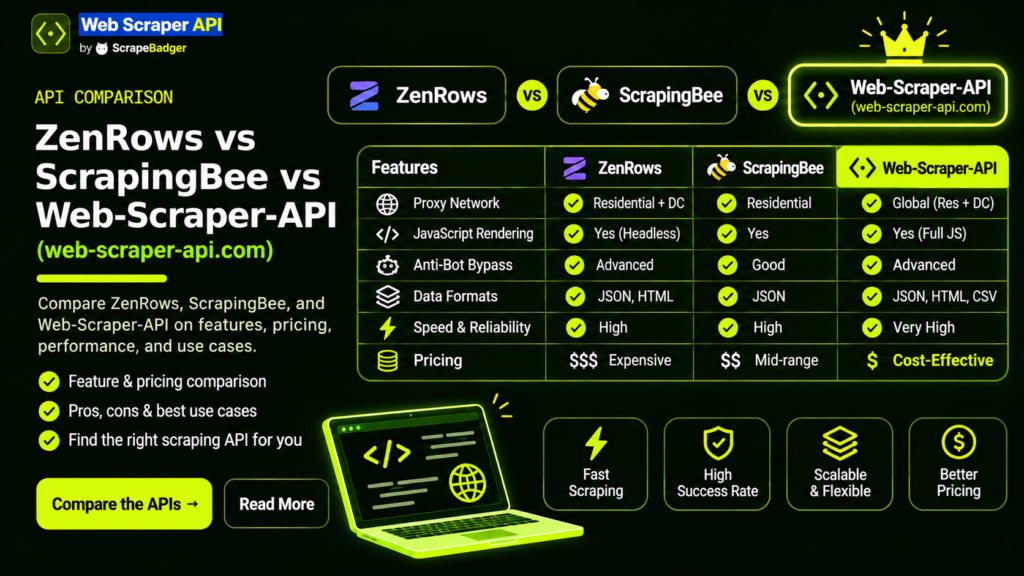
ZenRows and ScrapingBee both promise to get you past Cloudflare and DataDome. Both bill in credits. And both look cheap until you turn on the features a protected site actually needs.
So which web scraping API costs less for the pages you scrape? For this ZenRows vs ScrapingBee comparison we priced the protected page on every plan, not the credit, then checked what independent benchmarks say about getting through. Every price below comes from each vendor's own pricing page or docs, and every computed number shows its formula.
Full disclosure: Web-Scraper-API is our product. It shows up in one column of the cost table and in one short section. The rest of the post is about the two tools you came here for.
Quick answer
ScrapingBee is cheaper per credit on every plan size, so it wins on most protected pages. ZenRows wins once a big enough share of your targets need ScrapingBee's 75-credit stealth tier, because ZenRows tops out at 25 credits. At a $49 to $69 budget that crossover sits around 20% of pages. In the $99 to $249 range it's closer to 50%.
| ZenRows | ScrapingBee | |
|---|---|---|
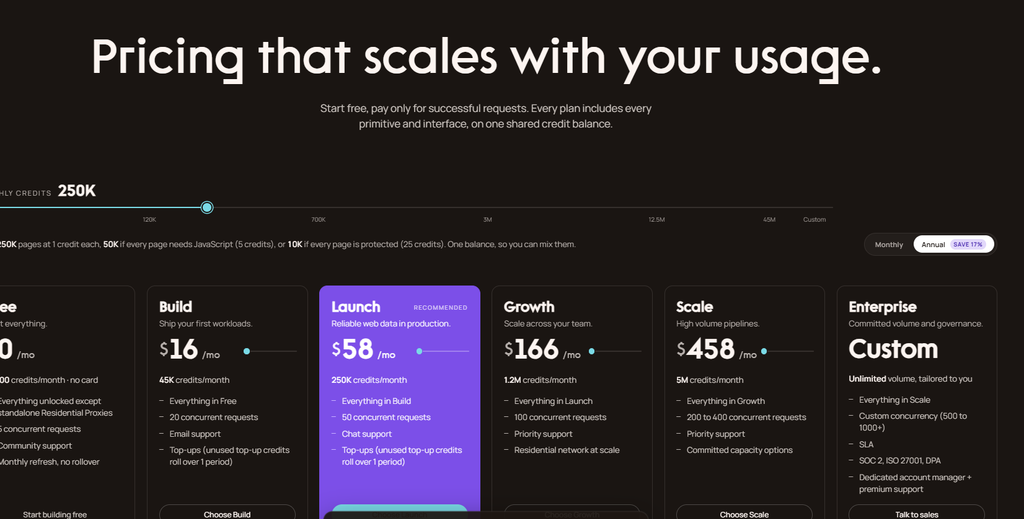
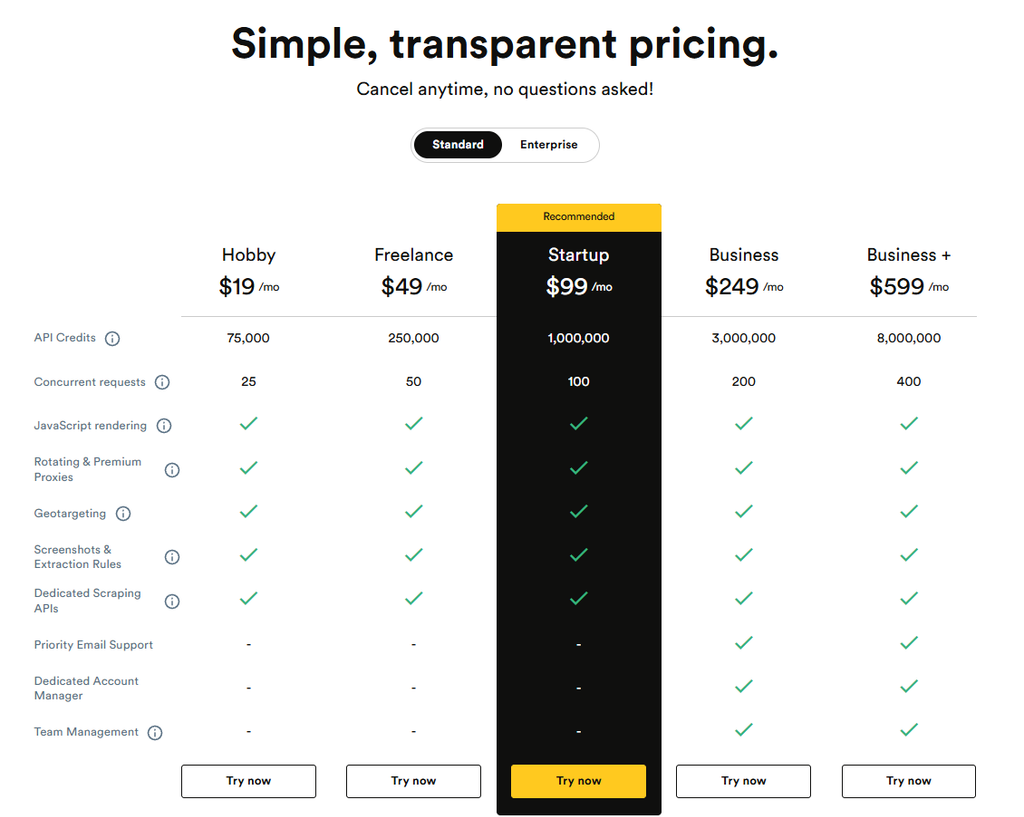
| Entry plan | $19/mo, 45,000 credits | $19/mo, 75,000 credits |
| Free tier | 5,000 credits/mo, no card | 1,000 trial credits, no card |
| Credits per protected page | 25 (JS + premium proxy) | 25 (JS + premium), or 75 (stealth) |
| Highest tier per request | 25 credits | 75 credits |
| Auto-escalation | Yes (mode=auto) | Yes (mode=auto, with max_cost cap) |
| Billed on failure | No (404 and 410 are billed) | No (404 and 410 are billed) |
| Proxyway 2025 success, 2 req/s | 70.39% | 84.47% |
| Best for | Targets that need stealth-level bypass | Everything up to premium + JS |
Who's behind each tool, and what changed this year
Both companies changed things in 2026 that most comparison posts haven't caught up with.
ZenRows rebuilt its pricing in August 2026. The old Developer, Startup and Business plans are gone. Now there's a permanent free plan, a $19 Build tier and a ladder up to Scale, all billed in one credit balance shared across its fetch, extract, crawl and browser products. If a post quotes ZenRows at "$69 for 250K basic or 10K protected results", it's describing the old structure.
ScrapingBee officially became part of Oxylabs' group in January 2026, after a deal announced in June 2025. It still runs as its own product with its own pricing, and it added a $19 Hobby plan this autumn. (We compare it against our own API on the ScrapingBee alternative page.)
Bottom line: compare current plans. Half the SERP is still pricing ZenRows from before August.
How each one bills a protected page
Both tools use nearly the same credit ladder for the first four rungs. That's the part people expect. The fifth rung is where they split.
| Configuration | ZenRows | ScrapingBee |
|---|---|---|
| Plain request, no JS | 1 | 1 |
| JS rendering | 5 | 5 |
| Premium (residential) proxy, no JS | 10 | 10 |
| Premium proxy + JS | 25 | 25 |
| Stealth proxy (JS always on) | no such tier | 75 |
| Google URLs on the HTML API | n/a | 15, or 75 with stealth |
ZenRows publishes those weights as fixed on every plan. ScrapingBee lists its costs in its credit system help article, and stealth requests can't switch JavaScript off, so you pay for the browser whether the page needs it or not.
One thing the ZenRows side of the marketing gets wrong: its ScrapingBee comparison implies ScrapingBee charges for failures. It doesn't. ScrapingBee's FAQ says it only charges for responses with a 200, 404 or 410 status. ZenRows' own pricing docs bill 404 and 410 too. So on dead URLs, both charge you. On blocks and timeouts, neither does.
The other gotcha is on ZenRows. Plan credits expire at every renewal, and only top-up credits roll over, once.
And ScrapingBee renders JavaScript by default. Forget render_js=false on a static page and you're paying 5 credits for a 1-credit job.
Bottom line: "protected" means 25 credits on both, until a site needs ScrapingBee's stealth pool. Then it's 75 on ScrapingBee and still 25 on ZenRows.
Cost per 1,000 protected pages, plan by plan
Here's what a protected page costs at matched budgets. The formula for every cell: plan price / plan credits x credits per page x 1,000.
| Budget | ZenRows, 25 credits | ScrapingBee, premium + JS (25) | ScrapingBee, stealth (75) | Web-Scraper-API, browser + premium (17) |
|---|---|---|---|---|
| ~$19 | $10.56 (Build B1) | $6.33 (Hobby) | $19.00 (Hobby) | n/a |
| $49 to $69 | $6.90 (Launch L1, $69) | $4.90 (Freelance, $49) | $14.70 | $1.39 (Starter, $49) |
| ~$99 to $129 | $4.95 (Launch L2, $99) | $2.48 (Startup, $99) | $7.43 | $1.22 (Growth, $129) |
| $199 to $299 | $4.15 (Growth G1, $199) | $2.08 (Business, $249) | $6.23 | $1.02 (Pro, $299) |
| $549 to $699 | $2.75 (Scale S1, $549) | $1.87 (Business+, $599) | $5.62 | $0.92 (Scale, $699) |
Look at the middle column. On a 25-credit page, ScrapingBee is cheaper in every band, often by half. ZenRows only pulls ahead when you're forced into ScrapingBee's stealth column.
So the real question is how many of your pages need stealth. If a share s of your protected pages needs it, ScrapingBee's blended cost is (premium cost) + s x (stealth cost minus premium cost). Set that equal to ZenRows and solve:
| Budget | ScrapingBee stays cheaper while stealth pages are under |
|---|---|
| ~$19 | 33% |
| $49 to $69 | 20% |
| ~$99 | 50% |
| ~$199 to $249 | 50% |
| $549 to $599 | 23% |
Example for the $49 to $69 band: 4.90 + s x (14.70 - 4.90) = 6.90, so s = 20%.
There's a catch, and it's a big one. This math assumes ZenRows gets through those stealth-level sites at 25 credits. If it doesn't, the cheaper rate buys you nothing. Which brings us to the benchmarks.
Bottom line: ScrapingBee is the cheaper default. ZenRows earns its place only when a sizable chunk of your targets would otherwise cost 75 credits a page.
Anti-bot results: what independent tests actually show
Every number in this section comes from a named third party, with its date. Vendor self-tests are labeled as such, and we don't rank on them.
Proxyway, Web Scraping API Report 2025 (December 2025). 15 heavily protected sites, tested at 2 and then 10 requests per second.
| Success, 2 req/s | Success, 10 req/s | Avg response | |
|---|---|---|---|
| ScrapingBee | 84.47% | 72.98% | 24.46s |
| ZenRows | 70.39% | 31.76% | 19.10s |
Proxyway said ZenRows suffered most at 10 req/s, likely from hitting concurrency limits, and that its results might not reflect ZenRows' full capability. Worth knowing: ZenRows was tested on its old plan structure, before the August repricing.
Scrape.do, 16 APIs on 7 domains (updated September 2026). Success meant page-specific elements were present, not just a 200. ScrapingBee scored 96.62% and ZenRows 96.29%. Basically a tie. The cost split is more telling: ZenRows needed its full 25-credit tier on Indeed, Zillow and Google, which pushed its blended price to $3.32 per 1,000, against $1.77 for ScrapingBee. ScrapingBee's weak spot was speed. Zillow averaged 57.9 seconds. Scrape.do doesn't publish test dates, concurrency or sample sizes, so treat it as directional.
Scrapeway (monthly, default settings). ZenRows read 15% in August 2026, 22% in September and 67% in October. ScrapingBee scored 33% in September and wasn't tested in October. Scrapeway runs each API with default configuration, so it measures out-of-the-box behavior, not what a tuned setup can do. Useful for spotting volatility. Not useful as a headline.
Why do these disagree so much? Different targets, different settings, different load. Proxyway hammered hard sites under concurrency. Scrape.do let each provider pick its tier per domain. Scrapeway left everything on defaults. Ask a different question, get a different winner.
Both vendors publish their own benchmarks too. ZenRows reports 99%+ on protected targets in its tests. Those are run on targets the vendor picked, so we don't use them to rank.
Bottom line: the only neutral test that stressed both under load put ScrapingBee ahead, and ZenRows fell off hard at 10 req/s. On a per-domain basis they look close. Test your own targets before you trust anyone's average, ours included.
Who picks the proxy tier
You often don't know in advance which pages need what. Both tools now handle that for you.
ZenRows' Adaptive Stealth Mode (mode=auto) starts with a basic request and escalates to JS rendering and premium proxies only when needed. You pay for the configuration that succeeds, and failed attempts cost nothing.
ScrapingBee added Auto Mode in July 2026. It works the same way, from 1 credit up through stealth at 75, and bills only the tier that works. It also takes a max_cost parameter. Set max_cost=25 and Auto Mode will never try the 75-credit stealth tier. That's a handy guardrail. The trade-off: pages that needed stealth just fail instead. ScrapingBee's Auto Mode is GET-only for now.
Here's how that plays out in your bill. Turn Auto Mode on with no cap and ScrapingBee will quietly spend 75 credits wherever it has to. That's your stealth share from the table above, decided for you. Run a week with max_cost=25, count the failures, and you know your real stealth share before you commit to a plan.
Bottom line: both escalate and both bill only success. ScrapingBee's max_cost gives you a cost ceiling ZenRows doesn't need, because ZenRows has no tier above 25.
Concurrency, free tier and credit expiry
| ZenRows | ScrapingBee | |
|---|---|---|
| Concurrency | 5 (Free), 20 (Build), 50 (Launch), 100 (Growth), 200 to 400 (Scale) | 25 (Hobby), 50 (Freelance), 100 (Startup), 200 (Business), 400 (Business+) |
| Free allowance | 5,000 credits every month | 1,000 credits, one-time trial |
| Unused credits | Plan credits expire at renewal | Expire at renewal |
ZenRows' free plan is the better testbed. 5,000 credits is 200 protected pages a month, for good. ScrapingBee's 1,000 trial credits cover 40 premium + JS pages, or just 13 stealth pages. That's not enough to judge a hard target.
Concurrency matters more than it looks. Proxyway's 10 req/s run is exactly where ZenRows dropped from 70% to 32%. If you need sustained throughput, check what your plan's concurrency really gets you on your targets.
Where Web-Scraper-API fits
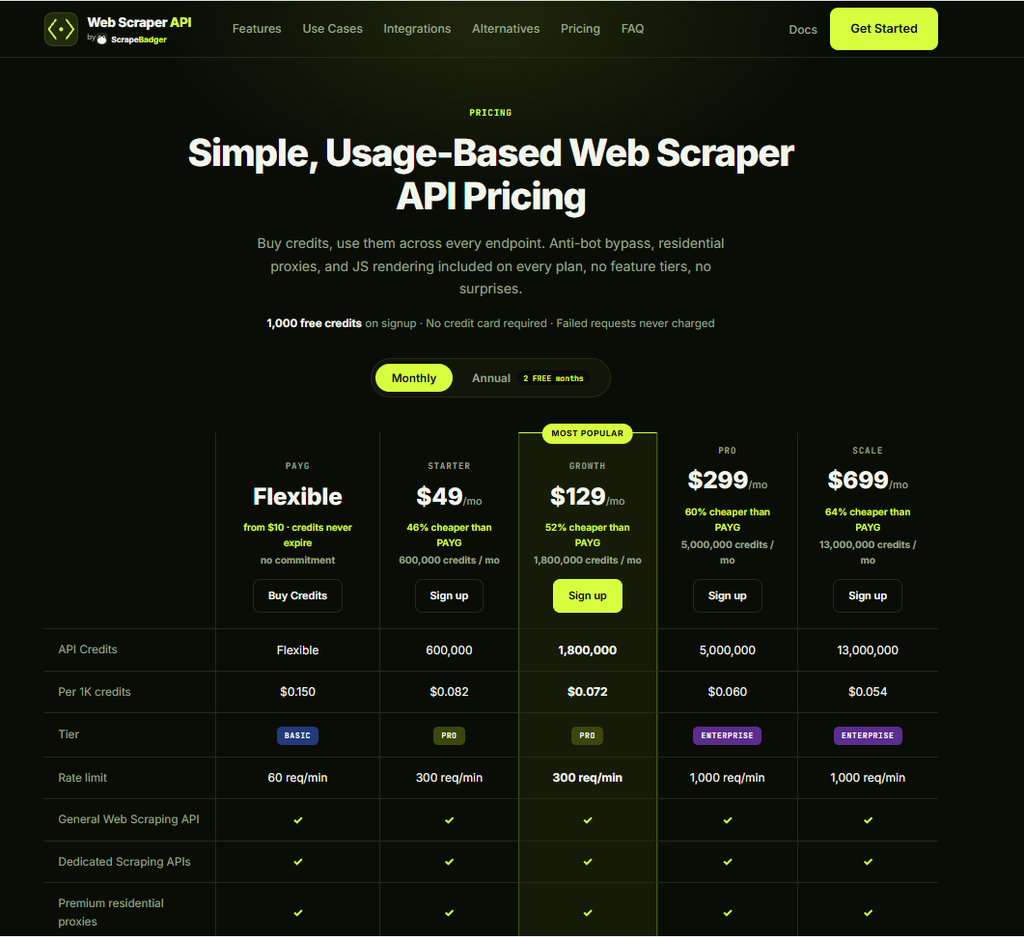
Want a third option? Web-Scraper-API bills by engine plus proxy. A browser request through premium proxies costs 17 credits, which is $1.39 per 1,000 pages on the $49 Starter plan ($49 / 600,000 x 17 x 1,000). There's no 75-credit tier, failed requests cost 0, and the escalate parameter steps up only when a request is blocked, billing only the method that succeeds. A max_cost cap works like ScrapingBee's.
Now the honest part:
- No independent benchmark includes us yet. Proxyway, Scrape.do and Scrapeway haven't tested Web-Scraper-API, so we can't show you a third-party success rate. Test it on your targets.
- Pay-as-you-go costs more per credit ($0.150 per 1,000) than any monthly plan, so a protected page on PAYG is $2.55 per 1,000.
- Our review base is small compared to either of these two.
- No crawl endpoint. ZenRows has one; we fetch pages you send.
Try Web-Scraper-API with 1,000 free credits, no card needed. Point it at the URLs that cost you 75 credits elsewhere.
ZenRows or ScrapingBee: pick by requirement
No overall winner here. It depends on your targets.
| If you need... | Pick |
|---|---|
| The lowest cost on premium + JS pages | ScrapingBee |
| Many targets that need stealth-level bypass (over ~20 to 50% of pages, by plan) | ZenRows |
| Higher success under sustained concurrency, per Proxyway | ScrapingBee |
| A free tier that refills every month | ZenRows |
| A hard cost cap on auto-escalation | ScrapingBee (max_cost) |
| Crawling a whole site from one call | ZenRows |
| The cheapest entry plan with the most credits | ScrapingBee Hobby (75,000 vs 45,000 at $19) |
Mixed target list? Route by domain. Send the 25-credit sites to ScrapingBee and the stealth-only ones to ZenRows. Two API keys is a small price for cutting a 75-credit page down to 25.
FAQ
Is ZenRows or ScrapingBee cheaper?
ScrapingBee, for most protected pages. Both charge 25 credits for premium proxy plus JS. ScrapingBee's credits cost less on every plan size: $4.90 per 1,000 such pages on its $49 plan against $6.90 on ZenRows' $69 plan. ZenRows becomes cheaper only when roughly 20 to 50% of your pages need ScrapingBee's 75-credit stealth tier.
What is the difference between ZenRows and ScrapingBee?
They share almost the same credit ladder, from 1 credit for a plain request to 25 for premium proxy plus JS. The difference sits at the top: ScrapingBee has a 75-credit stealth tier for the hardest sites, and ZenRows doesn't go above 25. ZenRows also bundles crawl, extract and browser sessions into one balance.
Does ScrapingBee charge for failed requests?
No. ScrapingBee only charges for responses with a 200, 404 or 410 status, and its Auto Mode bills only the configuration that succeeds. ZenRows works the same way: failed and retried requests are free, but 404 and 410 responses count as successful and are billed.
Can ZenRows and ScrapingBee bypass Cloudflare and DataDome?
Both target those systems, with results that vary by site. In Proxyway's December 2025 test of 15 heavily protected sites, ScrapingBee succeeded 84.47% of the time and ZenRows 70.39% at 2 requests per second. Scrape.do's September 2026 run had both near 96% across seven domains.
Who owns ScrapingBee?
Oxylabs' group. The acquisition was announced in June 2025, and ScrapingBee said it officially joined the group in January 2026. It still operates as a separate product with its own plans and pricing.
Do ZenRows credits roll over?
Plan credits don't. ZenRows' pricing docs say unused plan credits expire at every renewal. Top-up credits roll into the next billing period once, then expire. Upgrading mid-cycle carries your unused credits to the new plan one time.
The short version
Sort your target list by the tier each site actually needs. Run 20 URLs per domain on free credits, count how many need stealth, then read your answer off the break-even table. Below the line, ScrapingBee. Above it, ZenRows. If neither number looks good, put the same 20 URLs through Web-Scraper-API and compare.
Related reading
- ScrapingBee alternative: Web-Scraper-API compared
- ScrapingBee vs Scrapingdog vs Web-Scraper-API
- Anti-bot bypass with Web-Scraper-API
- The best ZenRows alternatives