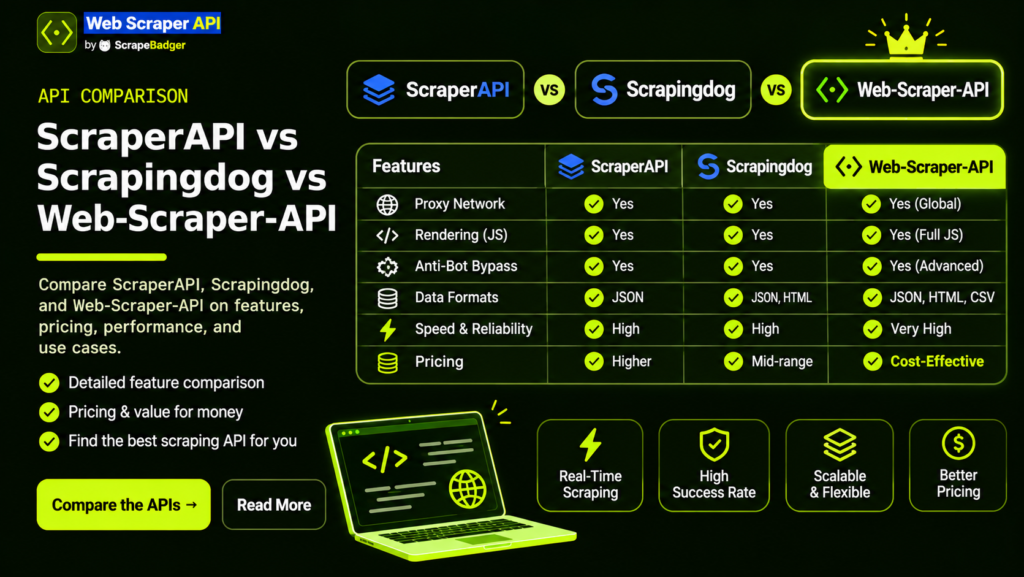
ScraperAPI and Scrapingdog both sell credits, and both look cheap on the pricing page. The catch is that a credit buys a very different amount of work on each one. A Google search costs 5 credits on Scrapingdog and 25 on ScraperAPI. A JavaScript page behind residential proxies costs 25 on both.
So the ScraperAPI vs Scrapingdog question, "which is cheaper?", has no single answer. It depends on what you scrape.
This post works out the real cost per 1,000 pages for four common workloads, then compares billing rules, proxies, endpoints and reliability evidence. We also include our own web scraping API, because it wins two of those workloads and loses the other two. Full disclosure: Web-Scraper-API is our product. Every number is linked to its source, the vendors' own pages wherever possible, and the formula sits under each table so you can rerun it with your plan.
Quick answer: pick by workload
Mostly scraping Amazon or Google? Pick Scrapingdog. If you scrape JavaScript-heavy pages behind anti-bot protection, or your volume comes in bursts, pick Web-Scraper-API. If you need ScraperAPI's structured endpoints and async batch jobs, that's a fair reason to pay its higher per-page cost.
| If your main workload is... | Pick | Why |
|---|---|---|
| Amazon product data | Scrapingdog | 1 credit per product call vs 5 (ScraperAPI) and 13 (us) |
| Google search results | Scrapingdog | 5 credits per search vs 20 (us) and 25 (ScraperAPI) |
| JS pages, no residential IPs | Split | We're cheapest on entry plans; Scrapingdog wins at the 1M-credit tier |
| JS pages behind residential IPs | Web-Scraper-API | 17 credits vs 25 on both others |
| Irregular or bursty volume | Web-Scraper-API | Pay-as-you-go from $10, credits never expire, failed requests free |
| Large structured-data pipelines | ScraperAPI | Structured endpoints across Google, Amazon, Walmart, eBay and Redfin, plus batch jobs up to 50,000 URLs |
Who's behind each one (and what changed in 2026)
ScraperAPI is the veteran of the three. It was founded in 2018 and sells one general scraping API plus structured endpoints, an async scraper and a low-code DataPipeline. The big 2026 news: ScraperAPI acquired Traject Data, the company behind Rainforest API and SerpWow. ScraperAPI says existing pricing and API keys don't change for now, and Traject's structured APIs will move onto its infrastructure over the coming months.
Scrapingdog is the budget-focused option. Its pitch is low prices and a long list of dedicated endpoints: its own comparison page claims over 63 of them, covering Google, Amazon, LinkedIn, Indeed and more. It also added a pay-as-you-go model alongside its subscriptions.
Web-Scraper-API is the general web scraper API powered by ScrapeBadger. It has one scrape endpoint with an HTTP engine and a browser engine, proxy tiers you pick per request, and dedicated endpoints for sites like Google and Amazon.
Bottom line: ScraperAPI is the established, feature-heavy choice. Scrapingdog competes on price. We compete on predictable billing for hard pages.
Pricing and credits: why the cheaper plan isn't the cheaper bill
Here are the plans side by side, monthly billing, at roughly comparable tiers.
| Plan | Price/month | Credits | Price per 1K credits | Concurrency or rate limit |
|---|---|---|---|---|
| ScraperAPI Hobby | $49 | 100,000 | $0.49 | 20 threads |
| ScraperAPI Startup | $149 | 1,000,000 | $0.149 | 50 threads |
| ScraperAPI Business | $299 | 3,000,000 | $0.0997 | 100 threads |
| Scrapingdog Lite | $40 | 200,000 | $0.20 | 5 concurrent |
| Scrapingdog Standard | $90 | 1,000,000 | $0.09 | 50 concurrent |
| Scrapingdog Pro | $200 | 3,000,000 | $0.067 | 100 concurrent |
| Web-Scraper-API Starter | $49 | 600,000 | $0.082 | 300 requests/min |
| Web-Scraper-API Growth | $129 | 1,800,000 | $0.072 | 300 requests/min |
| Web-Scraper-API PAYG | from $10 | ~67,000 per $10 | $0.150 | 60 requests/min |
On that table alone, Scrapingdog Standard looks like the obvious deal. It isn't always. A price per credit means nothing until you know how many credits each request burns.
| Request type | ScraperAPI | Scrapingdog | Web-Scraper-API |
|---|---|---|---|
| Plain HTML page | 1 | 1 | 3 |
| JavaScript rendering | 10 | 5 | 7 |
| Premium / residential proxy | 10 (ultra premium 30) | 10 | 13 |
| JS rendering + premium proxy | 25 (ultra premium 75) | 25 | 17 |
| Google search | 25 | 5 (advanced or mobile 10) | 20 |
| Amazon product | 5 | 1 | 13 |
Two things jump out. Plain HTML is our weakest row: 3 credits where both competitors charge 1. And ScraperAPI's combinations don't add up linearly. Premium plus render is 25, not 20, and ultra premium plus render is 75, not 40. On top of that, ScraperAPI adds a further 10 credits when a domain needs its Cloudflare, DataDome or PerimeterX bypass, according to its docs.
Bottom line: compare cost per page, never cost per credit. The next section does exactly that.
ScraperAPI vs Scrapingdog cost per 1,000 pages, workload by workload
Every figure below uses the same formula:
Cost per 1,000 pages = plan price ÷ plan credits × credits per request × 1,000
Example: Scrapingdog Lite on Google is $40 ÷ 200,000 × 5 × 1,000 = $1.00. We show two tiers for each provider: the entry plan and the plan closest to 1M credits.
| Workload | ScraperAPI Hobby / Startup | Scrapingdog Lite / Standard | Web-Scraper-API Starter / Growth |
|---|---|---|---|
| Amazon product page | $2.45 / $0.75 | $0.20 / $0.09 | $1.06 / $0.93 |
| Google search | $12.25 / $3.73 | $1.00 / $0.45 | $1.63 / $1.43 |
| JS page, standard proxy | $4.90 / $1.49 | $1.00 / $0.45 | $0.57 / $0.50 |
| JS page + premium proxy | $12.25 / $3.73 | $5.00 / $2.25 | $1.39 / $1.22 |
Amazon and Google data
Scrapingdog wins both, and it isn't close. At 1 credit per Amazon product call, Standard works out to nine cents per thousand products. Google at 5 credits lands at $0.45. ScraperAPI's 25-credit Google cost makes it the priciest of the three by a wide margin: $12.25 per 1,000 searches on Hobby.
We sit in the middle. Our Google endpoint costs 20 credits, so you pay $1.43 to $1.63 per 1,000 searches, roughly three times Scrapingdog's Standard rate. Our Amazon product endpoint costs 13 credits. If Amazon or Google is most of your bill, we're not your cheapest option. Simple as that.
Is there a case for ScraperAPI here? Yes, if you want parsed JSON across several marketplaces from one vendor. Its structured endpoints cover Google, Amazon, Walmart, eBay and Redfin, and the Traject deal points to more coming.
JavaScript-heavy pages
This one depends on your tier. On entry plans, our 7-credit browser request beats Scrapingdog Lite: $0.57 per 1,000 pages against $1.00. Move up to around a million credits and Scrapingdog Standard edges ahead, $0.45 against our $0.50.
Add residential proxies and the picture flips hard. Scrapingdog and ScraperAPI both charge 25 credits for JS plus premium proxy. We charge 17. That's $1.22 to $1.39 per 1,000 pages on our plans, against $2.25 to $5.00 on Scrapingdog and $3.73 to $12.25 on ScraperAPI. If a target needs ScraperAPI's ultra premium pool with rendering, the cost on Startup jumps to $11.18 per 1,000.
It's our clearest win, and it's the workload that surprises people most on the invoice, because sites behind Cloudflare, DataDome or Akamai usually need both a real browser and residential IPs.
Irregular volume
Subscriptions punish uneven usage. Scrapingdog's subscription credits don't carry over month to month. ScraperAPI only offers pay-as-you-go overage from its Scaling plan ($475/month) upward, so on Hobby, Startup and Business, running out means upgrading.
Our PAYG wallet starts at $10, charges $0.150 per 1,000 credits and never expires. A JS-rendered page costs $1.05 per 1,000 on PAYG. That's dearer than our subscription rate, but you pay nothing in the months you don't scrape. Scrapingdog's PAYG is the closest match here; check its pricing page for the current rate.
Bottom line: Scrapingdog for Amazon and Google, Web-Scraper-API for protected JS pages and spiky volume, and a genuine toss-up for plain JS pages.
Billing rules that change the math
The cost table assumes every request succeeds. Real scraping doesn't work that way, so the billing rules matter as much as the rates.
- ScraperAPI bills 200 and 404 responses, plus requests you cancel before its 70-second window ends, per its credit docs. Every response carries an
sa-credit-costheader, and amax_costparameter rejects any request that would cost more than your cap. That cap is a genuinely useful guardrail. - Scrapingdog bills 200 and 404 responses. If every retry fails within 60 seconds, it returns a 410 and doesn't charge you.
- Web-Scraper-API doesn't charge for failed requests: blocks, timeouts, errors and empty responses all cost 0 credits, on every plan, including PAYG. Retries are free too, and when a request escalates to a stronger method, you pay only for the method that worked.
Notice the 404 detail. If you crawl a list of product URLs and a tenth of them are dead, both ScraperAPI and Scrapingdog charge for those dead pages. Not a dealbreaker. But it belongs in your estimate.
Bottom line: all three spare you most block-related costs. ScraperAPI and Web-Scraper-API both let you cap cost per request, and our failed-request policy is the broadest of the three.
Proxies, geotargeting and concurrency
Geotargeting is ScraperAPI's sneakiest gate. Hobby and Startup are limited to US and EU targeting, and country-level targeting starts at Business, $299/month. If you need prices from Brazil or Japan, budget for that tier from day one. Scrapingdog lists geotargeting on every plan, Lite included. Our country targeting is a request parameter on every plan, with residential IPs in 150+ countries.
Concurrency cuts the other way. Scrapingdog Lite allows just 5 concurrent requests. That's fine for a nightly job and painful for anything that fires requests in parallel. ScraperAPI's Hobby gives you 20 threads for $9 more.
One caution on comparing us: we publish a rate limit (300 requests per minute on Starter), not a thread count. The two aren't the same unit. A thread count caps how many requests are in flight at once, a rate limit caps how many start per minute. If your average request takes 10 seconds, 300 per minute means about 50 in flight, but that number changes with response time. Test with your own targets.
Bottom line: ScraperAPI's cheap plans lock you to US and EU IPs, and Scrapingdog's cheapest plan locks you to 5 parallel requests. Check which limit hits your workload first.
Endpoints, output and developer surface
ScraperAPI has the deepest toolkit for building pipelines. Beyond the main API and structured endpoints, it runs an async service that accepts batch jobs of up to 50,000 URLs, supports webhooks, and offers DataPipeline for scheduled scraping without code.
Scrapingdog's strength is breadth of dedicated endpoints at low credit costs. Its general API is GET-based with simple flags (dynamic=true for rendering, premium=true for residential proxies). We found a community-built MCP server for Scrapingdog; if you need an official one, confirm with Scrapingdog first.
Web-Scraper-API takes a POST request with a JSON body: URL, engine, proxy tier, country, output format (HTML, Markdown, plain text or screenshot) and a max_cost cap of its own. There are SDKs for Python, Node and a CLI, and a hosted MCP server with 300+ tools across 30+ products for Claude, Cursor and other agents. See the docs for the full parameter list.
What we don't have: a crawl or site-map endpoint. If you need to discover URLs across a site, you'll handle that in your own code.
Bottom line: ScraperAPI for batch pipelines, Scrapingdog for cheap dedicated endpoints, us for one flexible endpoint with per-request cost control and agent tooling.
Reliability: what independent tests show
Here's the honest part. There's no neutral, widely accepted benchmark that tests all three of these side by side, and the published numbers swing wildly.
Scrapingdog's own test from January 2026 shows 100% success for itself on Amazon at 5.48 seconds, against 40.65 seconds for ScraperAPI. That's a vendor grading itself. Scrapeway's tracking, which runs default settings across 11 targets, puts Scrapingdog at 34% success. ZenRows' July 2026 benchmark, also run by a competitor, put ScraperAPI at 49% success and the slowest average response time in its test, 36.0 seconds.
Why so different? Target choice, settings and success definitions all vary between tests. A provider that's flawless on Amazon can fail on a DataDome-protected retailer.
We haven't benchmarked ourselves against these two, so we won't quote a success rate. Better move: run 50 of your real URLs through each provider's free credits and count pages where the data you need actually shows up.
Bottom line: treat every success-rate claim, ours included, as a hypothesis until it's tested on your targets.
Which one should you pick?
| Your requirement | Pick |
|---|---|
| Lowest cost on Amazon or Google data | Scrapingdog |
| Cheapest plan that still runs 20+ parallel requests | ScraperAPI Hobby |
| Protected JS pages that need residential IPs | Web-Scraper-API |
| Country targeting outside US/EU on a small budget | Scrapingdog or Web-Scraper-API |
| Scraping in bursts, nothing some months | Web-Scraper-API PAYG |
| Batch jobs of tens of thousands of URLs, webhooks, low-code scheduling | ScraperAPI |
| Mostly plain HTML at high volume | Scrapingdog |
async batches and cost caps over raw price. Just price it at the Business tier if you need geotargeting outside the US and EU.
Choose Scrapingdog if Amazon, Google or plain HTML make up most of your volume. It's the cheapest of the three there, by a lot. Watch the 5-request concurrency on Lite.
Choose Web-Scraper-API if your hard targets need a browser plus residential proxies, or your volume is unpredictable. Where we're weaker: Amazon and Google cost more than on Scrapingdog, plain HTML costs 3 credits instead of 1, PAYG is pricier per credit than our plans, and our review base is still small.
FAQ
Is Scrapingdog cheaper than ScraperAPI?
For most workloads, yes. Scrapingdog charges 5 credits per Google search against ScraperAPI's 25, and 1 credit per Amazon product call against 5. Its plans also cost less per credit at similar tiers. The gap closes for JavaScript pages behind premium proxies, where both charge 25 credits per request.
Which is better for scraping Google search results, ScraperAPI or Scrapingdog?
On cost, Scrapingdog. A standard Google search is 5 credits there (10 for advanced or mobile results) and 25 on ScraperAPI. That's $0.45 against $3.73 per 1,000 searches at the 1M-credit tier, and the gap is wider on entry plans ($1.00 against $12.25). ScraperAPI's case rests on its structured Google endpoints for search, news, jobs, shopping and maps, all under one key, which helps if you track more than organic rankings.
Which is better for Amazon scraping?
Scrapingdog is the cheaper option, at 1 credit per Amazon product request in its docs. ScraperAPI charges 5 credits for Amazon pages. Web-Scraper-API's Amazon product endpoint costs 13 credits, so it isn't the budget pick for Amazon-heavy workloads.
Do ScraperAPI and Scrapingdog charge for failed requests?
Both skip charges for most failures on their side, but both bill 404 responses. So if 1,000 of your 10,000 product URLs are dead, you pay for those 1,000. ScraperAPI also bills requests you cancel before its 70-second window. Scrapingdog returns a free 410 when all retries fail within 60 seconds. Web-Scraper-API doesn't charge for blocks, timeouts, errors or empty responses.
Does ScraperAPI have pay as you go?
Only from the Scaling plan ($475/month) upward, where you can keep scraping at a fixed per-credit rate up to a monthly cap you set. On Hobby, Startup and Business, running out of credits means upgrading. Web-Scraper-API's PAYG starts at $10 with credits that never expire.
Can I geotarget on ScraperAPI's Hobby plan?
Only within the US and EU. Hobby and Startup are limited to those two regions, and country-level geotargeting starts on the Business plan at $299/month. Scrapingdog lists geotargeting on every plan, and Web-Scraper-API supports country targeting on every plan.
How many requests do 100,000 ScraperAPI credits get me?
Anywhere from 100,000 down to 1,333. Plain pages cost 1 credit, so you get 100,000. JS-rendered pages cost 10 (10,000 requests), Google searches 25 (4,000), and ultra premium proxies with rendering 75 (1,333).
The short version
Price your two biggest targets with the formula above before you pick a plan. For most teams that settles it. Amazon and Google point to Scrapingdog. Protected sites or uneven volume point to Web-Scraper-API. And if pipeline features matter more than the lowest price, ScraperAPI earns its premium.
Related reading