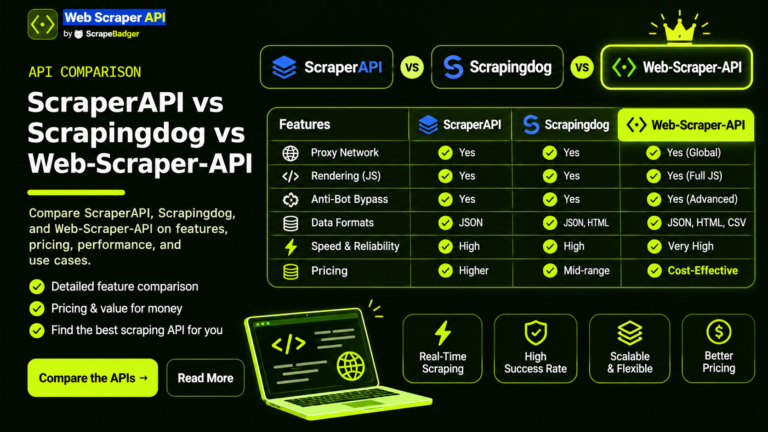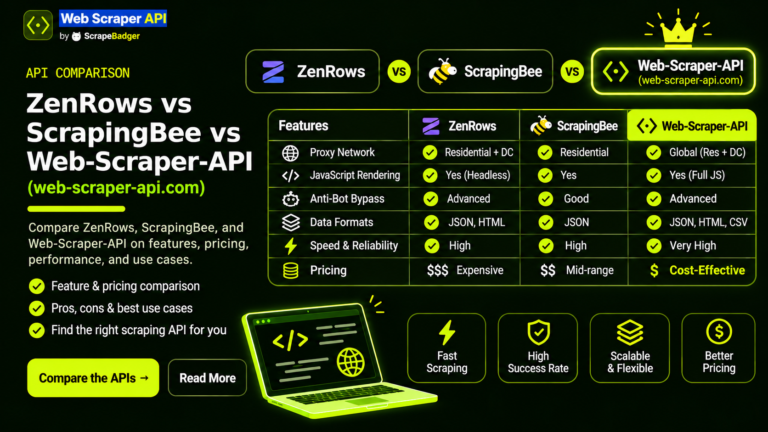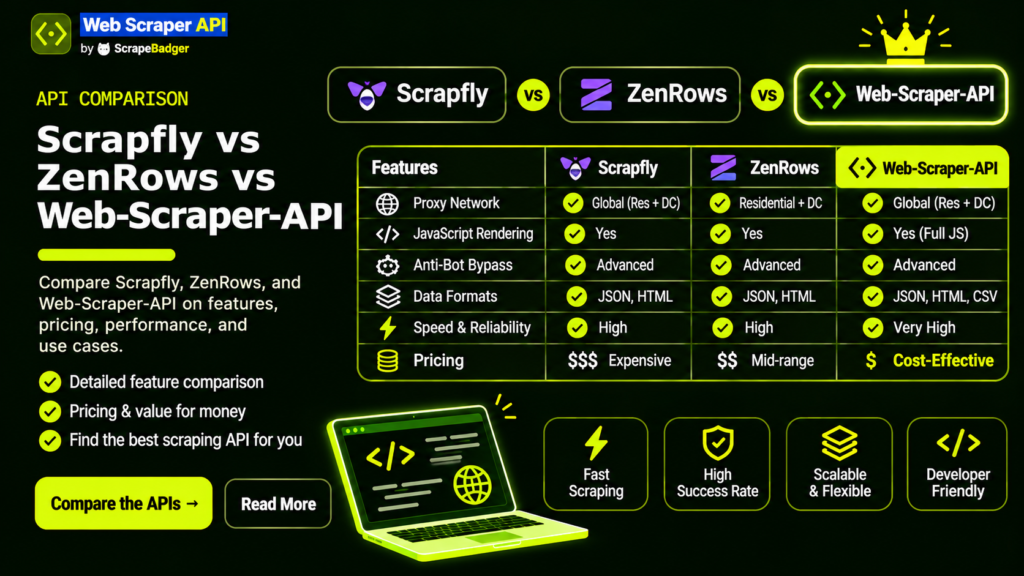
Scrapfly vs ZenRows comes down to a strange split. Scrapfly sells the cheaper credit, ZenRows charges fewer credits for a protected page. So which one is actually cheaper? It depends on what your pages look like, and the pricing pages won't do that math for you.
We did it. We priced 1,000 successful pages on three workloads (static HTML, JavaScript-rendered pages, and protected pages behind residential IPs) at three matched budgets, using each provider's own pricing and billing docs. Every number below has its formula next to it.
We also put a third option in the table: our own web scraping API. Full disclosure: Web-Scraper-API is our product. It loses one of the three workloads, and we'll show you which.
The quick answer
Static HTML goes to Scrapfly, the cheapest of the three. For JavaScript-rendered pages, Scrapfly and Web-Scraper-API land within 10 cents of each other. On protected pages, Web-Scraper-API costs less than half of what Scrapfly does and about a quarter of ZenRows. ZenRows wins on the free tier and on the smallest monthly bill.
| Scrapfly | ZenRows | Web-Scraper-API | |
|---|---|---|---|
| Best for | Static HTML at volume, crawling | Teams that want a recurring free tier | Protected and JS-heavy pages |
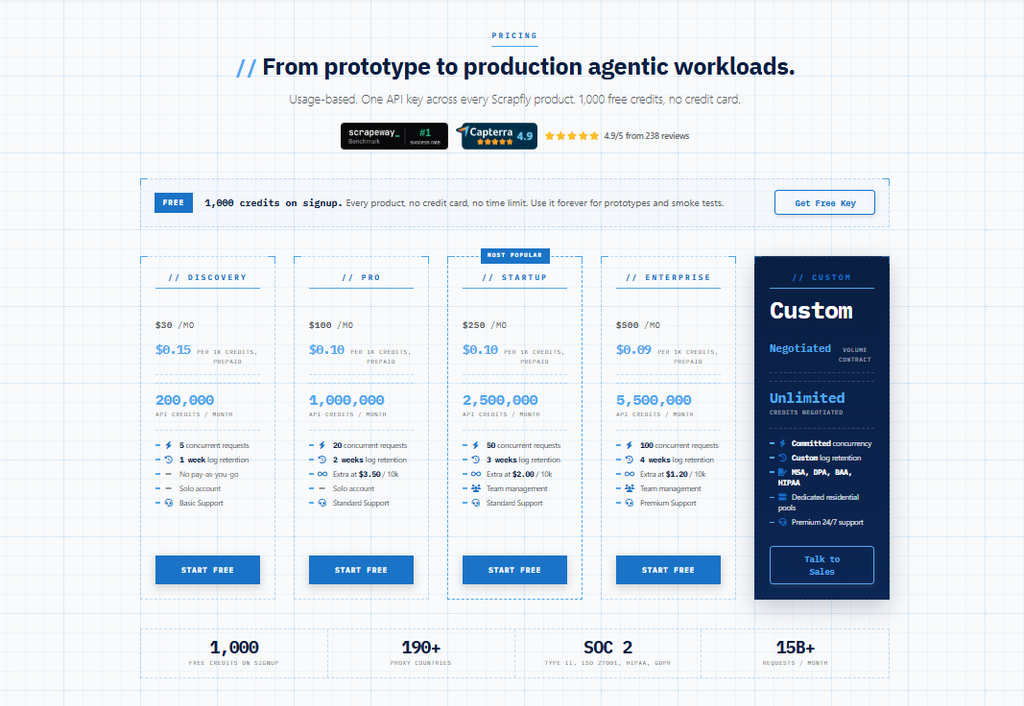
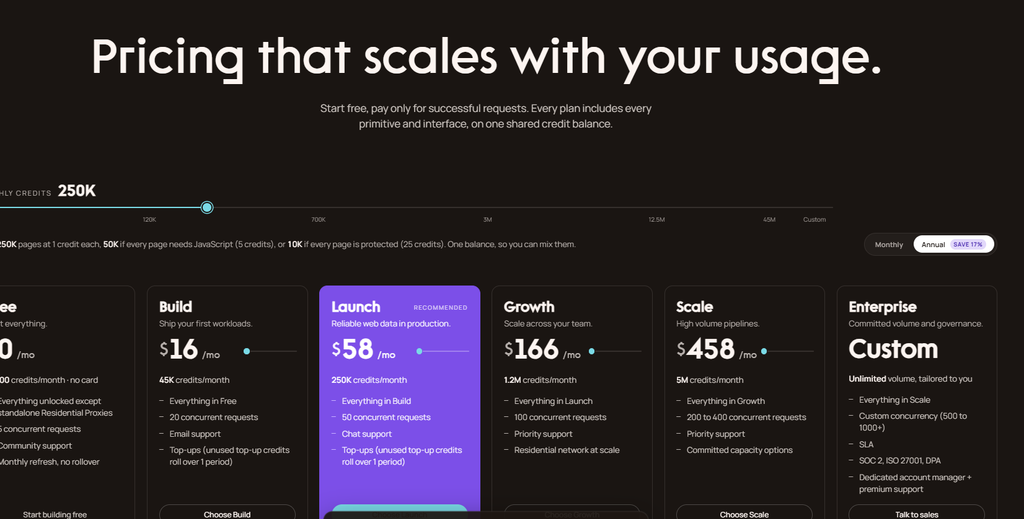
| Free tier | 1,000 credits, once | 5,000 credits every month | 1,000 credits, no card |
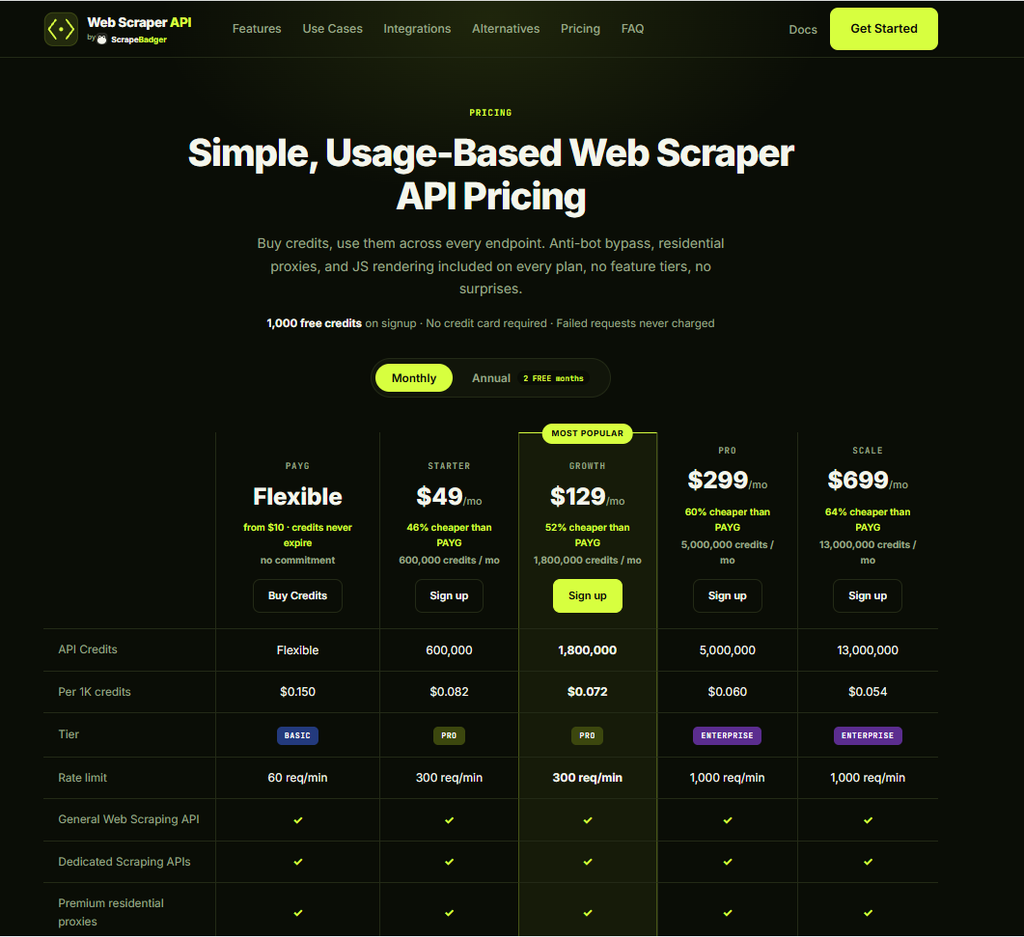
| Cheapest paid plan (monthly) | $30 for 200,000 credits | $19 for 45,000 credits | $49 for 600,000 credits |
| Credits per page: static / JS / protected | 1 / 6 / 30 | 1 / 5 / 25 | 3 / 7 / 17 |
| Cost per 1,000 protected pages, mid budget | $3.00 | $4.61 | $1.22 |
| Billed for failed requests? | No (with a fairness cap) | No | No |
Who's behind each tool
Scrapfly is a scraping API with five products on one credit pool, including a Crawler API and a Screenshot API. Its Anti Scraping Protection (ASP) flag handles bot walls, and it publishes SDKs for Python, TypeScript, Go and Rust.
ZenRows sells a Universal Scraper API plus a scraping browser, residential proxies, Batch and Crawl, all drawing on one credit balance. It repackaged its plans in 2026 into Build, Launch, Growth and Scale. A lot of comparison posts (ZenRows' own included) still quote the old $69 "Developer" plan, which no longer exists.
Web-Scraper-API is a managed scraping API, powered by ScrapeBadger. One POST call handles proxies, rendering and anti-bot bypass for Cloudflare, DataDome, Akamai, Imperva, PerimeterX and Kasada, with residential proxies in 150+ countries.
Bottom line: Scrapfly and ZenRows are platforms with several products each. Web-Scraper-API is the narrower tool, and we'll get to what it's missing.
How the credits work on each
All three sell credits. None of them charge one credit per page. The multiplier is where the money goes.
| Workload | Scrapfly | ZenRows | Web-Scraper-API |
|---|---|---|---|
| A. Static HTML, no protection | 1 (datacenter proxy) | 1 (standard) | 3 (HTTP engine + simple proxy) |
| B. JS-rendered, unprotected | 6 (datacenter + browser) | 5 (JS rendering) | 7 (browser + simple proxy) |
| C. Protected, JS + residential | 30 (residential + browser) | 25 (JS + premium proxy) | 17 (browser + premium proxy) |
Sources: Scrapfly billing docs, ZenRows pricing, ScrapeBadger announcements.
The three models behave differently once a site fights back.
Scrapfly starts every request at 1 credit on a datacenter IP and adds from there: residential is 25, the browser adds 5. With ASP on, Scrapfly can upgrade your proxy pool and browser mid-request to get past a block. That's how it succeeds on hard sites. It also means the final cost is decided after you send the request. Its own compare page calls a blocked-site request "30+ credits (varies by target)". You can cap it with the cost_budget parameter, though set it too low and the call is rejected.
ZenRows uses four fixed weights: 1, 5, 10 and 25. They don't change by plan, and 25 is the top weight. Predictable. The catch: protected targets sit at 25, and a plan's credit count only reads like a page count at 1.
Web-Scraper-API adds an engine cost to a proxy cost. HTTP is 1, the browser is 5. A simple proxy adds 2, premium (residential) adds 8. With escalation on, retries are free and you're billed only for the method that succeeds.
So what does that mean in dollars? Credits aren't priced the same on each, so the table above doesn't answer it yet.
Bottom line: ZenRows is the most predictable per request, Scrapfly the most variable, and we sit in between with a fixed engine-plus-proxy sum.
We priced 1,000 pages three ways
Here's the formula we used for every cell:
cost per 1,000 pages = plan price / plan credits × credits per page × 1,000We matched plans by budget, roughly $20 to $50, $100 to $130 and $250 to $300 a month, all on monthly billing.
| Budget | Plan | Price per 1K credits | A: static | B: JS-rendered | C: protected |
|---|---|---|---|---|---|
| Entry | Scrapfly Discovery ($30, 200K credits) | $0.150 | $0.15 | $0.90 | $4.50 |
| Entry | ZenRows Build B1 ($19, 45K) | $0.422 | $0.42 | $2.11 | $10.56 |
| Entry | Web-Scraper-API Starter ($49, 600K) | $0.082 | $0.24 | $0.57 | $1.39 |
| Mid | Scrapfly Pro ($100, 1M) | $0.100 | $0.10 | $0.60 | $3.00 |
| Mid | ZenRows Launch L3 ($129, 700K) | $0.184 | $0.18 | $0.92 | $4.61 |
| Mid | Web-Scraper-API Growth ($129, 1.8M) | $0.072 | $0.22 | $0.50 | $1.22 |
| Upper | Scrapfly Startup ($250, 2.5M) | $0.100 | $0.10 | $0.60 | $3.00 |
| Upper | ZenRows Growth G2 ($279, 2M) | $0.140 | $0.14 | $0.70 | $3.49 |
| Upper | Web-Scraper-API Pro ($299, 5M) | $0.060 | $0.18 | $0.42 | $1.02 |
Three things jump out.
First, static HTML is Scrapfly's. At $0.10 per 1,000 pages on Pro it beats us by more than 2x, because a static page costs us 3 credits and costs Scrapfly 1. If most of your URLs are plain HTML, that's the whole decision.
Second, rendered pages are a near tie: $0.60 for Scrapfly, $0.50 for us. Real money at 10 million pages a month. Noise at 50,000.
Third, protected pages flip the table. A 30-credit page on Scrapfly Pro is $3.00 per thousand. A 25-credit page on ZenRows Launch L3 is $4.61. Ours is $1.22. That's where the multiplier gap shows up in dollars.
What does a plan actually buy, then? Scrapfly Discovery gets you 200,000 static pages, 33,333 JS-rendered pages or 6,666 protected ones. ZenRows' Launch L1 ($69, 250,000 credits) gets you 250,000, 50,000 or 10,000. Web-Scraper-API Starter ($49) gets you 200,000, 85,714 or 35,294.
One trap is worth calling out. ZenRows Build B1 has the lowest bill of anything here at $19 a month. It's also the most expensive per page on every workload: $10.56 per 1,000 protected pages. Cheap plan, expensive page. B1's whole allowance covers 1,800 protected pages. Launch L1 at $69 covers 10,000 of them, at $6.90 per 1,000.
Bottom line: Scrapfly for static, a near tie on rendered pages, Web-Scraper-API for protected ones.
Try the protected-page math on your own URLs. 1,000 free credits, no card, and failed requests cost nothing. Get your API key
The costs that don't show on the pricing page
Plan math is the start. A few billing rules move the real number.
Failed requests. All three say you don't pay for failures. Scrapfly adds a fairness policy: if a large share of your traffic fails over an hour, failed requests can be billed again, and an account that keeps scraping a protected site without ASP can be suspended. ZenRows bills 404 and 410 responses as successful. We don't bill blocks, timeouts, errors or empty responses.
Bandwidth on Scrapfly. The first megabyte of each response is free. After that, Scrapfly bills in 100 KB slices: 3 credits per slice on datacenter IPs, 10 on residential. Most HTML stays under 1 MB, so you'll rarely notice. A 2 MB response on a residential IP, though, adds 100 credits to a 30-credit request. Heavy product pages and infinite-scroll listings are where that bites.
Credits that expire. ZenRows plan credits expire at each renewal, and top-up credits roll over once. Scrapfly's pricing page doesn't say whether unused credits carry over, so assume they don't. Discovery also hard-caps when you run out, with no overage. Our subscription credits refresh each period, but pay-as-you-go credits ($0.150 per 1,000) never expire.
Concurrency at the same budget. At roughly $100 to $130, Scrapfly Pro gives you 20 concurrent requests and ZenRows Launch gives you 50. Our Growth plan is rated at 300 requests per minute, a rate limit rather than a concurrency cap, so compare against your own throughput.
Bottom line: read the failure policy and the bandwidth rule before you trust any per-page number, including ours.
Success rates: why the benchmarks disagree
A cheap page that never arrives costs you nothing on the bill and everything on the project. So which one actually gets through? The honest answer is that the public numbers don't agree.
| Source | Window | Scrapfly | ZenRows |
|---|---|---|---|
| ZenRows' own benchmark (4 targets, 400 requests each) | 19 Jun 2026 | 98.5% | 99.0% |
| Scrapeway, as reported by Spider | 14 to 28 Aug 2026 | 98% | 15% |
| Scrapeway, as cited on Scrapfly's compare page | not dated | 98% | 58% |
Same tool, 15% in one test and 99% in another. Why? Target lists differ. Default settings differ, and a tool tested "out of the box" may not switch on the protection the site needs. And the vendor running the test picks the targets. ZenRows' benchmark comes from ZenRows, and Scrapfly cites Scrapeway on every one of its compare pages.
No independent benchmark we found includes Web-Scraper-API, so we won't claim a success rate for it.
What should you do with this? Treat our cost table as a ranking of tools that both get the page. Then test your hardest URLs yourself. All three have free credits for exactly that.
Bottom line: Scrapfly reads consistently high across sources. ZenRows' numbers depend on who's measuring. Test before you commit.
Features beyond the scrape
Cost isn't the only reason to pick a tool. Here's where each one goes further.
- Crawling: Scrapfly has a Crawler API and ZenRows lists Crawl. Web-Scraper-API doesn't crawl. You send URLs; it doesn't discover them.
- Bulk jobs: ZenRows Batch takes up to 100,000 URLs per job.
- Screenshots: Scrapfly has a dedicated Screenshot API (60 credits per full-page capture). We return screenshots as an output format.
- Structured data: Scrapfly has an Extraction API, ZenRows has Extract, and we have AI extraction (+2 credits) plus dedicated endpoints that return JSON for sites like Amazon and Google.
- Agents: ZenRows ships an MCP server and CLI in its Agent Toolkit. Ours is hosted at mcp.scrapebadger.com with OAuth and covers 300+ tools across 30+ products.
- SDKs: Scrapfly covers Python, TypeScript, Go and Rust. We cover 12 languages, including Python (
pip install scrapebadger) and Node (npm install scrapebadger).
Bottom line: if you need site-wide crawling, Scrapfly or ZenRows. If you already have the URLs, all three will do.
Scrapfly vs ZenRows: which one should you pick?
| If you need... | Pick | Why |
|---|---|---|
| Mostly static HTML at high volume | Scrapfly | $0.10 per 1,000 pages on Pro |
| JS-rendered pages, no bot wall | Scrapfly or Web-Scraper-API | $0.60 vs $0.50 per 1,000 at the mid budget |
| Protected pages behind residential IPs | Web-Scraper-API | $1.22 per 1,000 vs $3.00 and $4.61 |
| A free tier you can keep using | ZenRows | 5,000 credits every month |
| The smallest monthly bill | ZenRows | Build B1 at $19, if volume stays low |
| Site-wide crawling or a screenshot API | Scrapfly | Crawler and Screenshot APIs |
| Credits that never expire | Web-Scraper-API | Pay-as-you-go credits don't expire |
Mixed workload? Most people have one. Split your URL list into static, rendered and protected, multiply each slice by the cost above, and add them up. That number beats any headline plan price.
Bottom line: there's no overall winner. There's a winner for your URL mix.
FAQ
Is Scrapfly cheaper than ZenRows?
On static and JS-rendered pages, yes. Scrapfly Pro works out to $0.10 and $0.60 per 1,000 pages, against $0.18 and $0.92 on ZenRows' Launch L3 at a similar budget. On protected pages Scrapfly charges 30 credits to ZenRows' 25, but its cheaper credits still put it ahead at the mid budget: $3.00 vs $4.61 per 1,000.
How many credits does ZenRows charge for JavaScript rendering?
Five credits per successful request. Premium proxies alone are 10, and JavaScript rendering plus premium proxies is 25. Those weights are the same on every plan; only the number of credits you buy changes. On the $69 Launch L1 plan, 250,000 credits covers 50,000 rendered pages.
Why does Scrapfly charge 25 credits for residential proxies?
Scrapfly doesn't break the number down. Its billing docs simply price a residential request at 25 credits, against 1 on a datacenter IP, before rendering. Add the browser and it's 30. With ASP on, Scrapfly may switch to residential automatically when a site blocks you, so a request you expected to cost 1 credit can end up at 25 or 30.
Does ZenRows charge for failed requests?
No. ZenRows bills only successful requests, and failed or retried requests don't use credits. One detail: HTTP 404 and 410 responses count as successful, so they're billed. Scrapfly and Web-Scraper-API also skip failed requests, though Scrapfly applies a fairness policy when too much of your traffic fails.
Which is better for Cloudflare-protected sites, Scrapfly or ZenRows?
None of the published tests isolate Cloudflare, and on protected sites in general it depends on whose benchmark you read. Scrapfly scores around 98% in every source we found. ZenRows scores 99% in its own June 2026 test and 15% to 58% in Scrapeway's numbers. Run your own Cloudflare targets through both on free credits. For cost, Web-Scraper-API's 17-credit protected request is the cheapest of the three.
Do Scrapfly credits roll over?
Scrapfly's pricing page doesn't say, so plan as if they don't. What it does say: Discovery stops at its quota, while Pro and higher plans switch to pay-as-you-go overage. ZenRows plan credits expire at renewal, with top-ups rolling over once. Web-Scraper-API's pay-as-you-go credits never expire.
The takeaway
Scrapfly wins static pages, ZenRows wins the free tier, and Web-Scraper-API wins protected pages on cost. Before you sign up for anything, take your 20 hardest URLs and spend the free credits on them. The bill you get from that test is the one that matters.
Related reading