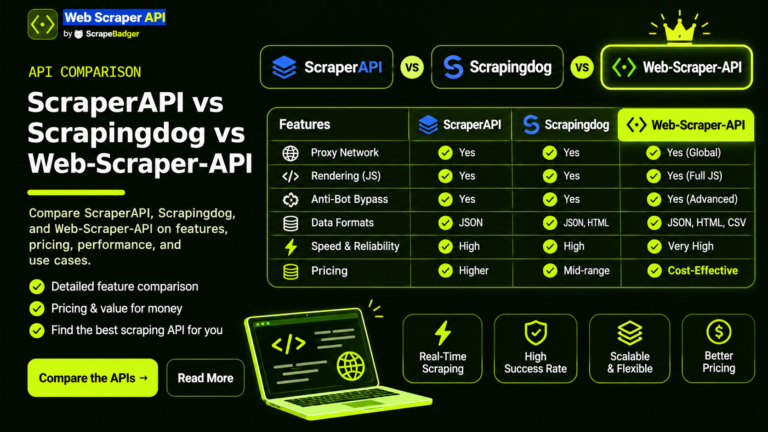
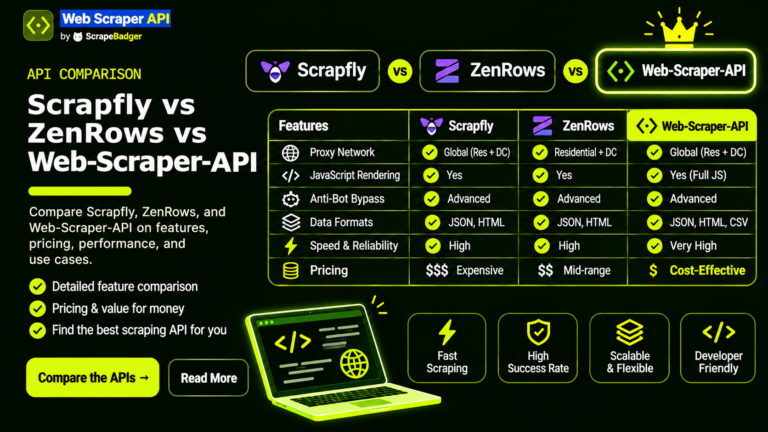
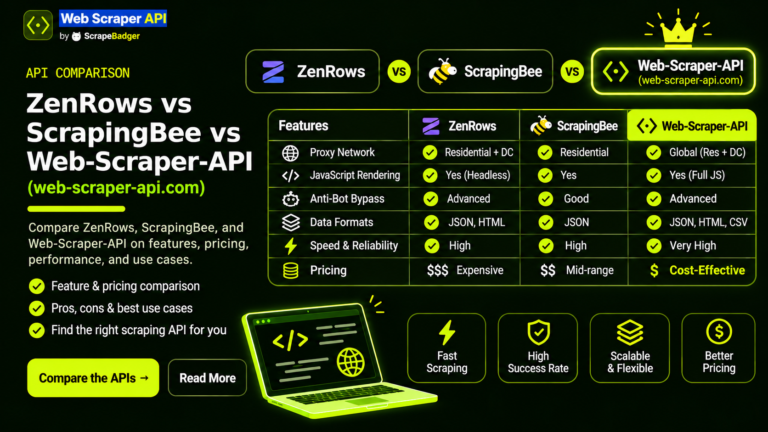
Every scraping API looks cheap on its pricing page. Then you point it at a site that needs JavaScript and a residential IP, and the same plan buys you a fraction of the pages you thought it would.
So we compared ten of the best web scraping APIs on the number that matters: what 1,000 successful pages cost on your kind of workload. We also checked who bills you for blocked requests, who has a real MCP server for AI agents, and where each one genuinely wins. Every price comes from the vendor's own pricing or docs page, checked in October 2026.
Full disclosure: WebScraperAPI, the web scraper API this site is about, is our product. It's on this list, and so are its weak spots.
Quick answer: the best web scraping APIs at a glance
There's no single winner. Mixed workloads and AI agents? Start with WebScraperAPI. The hardest anti-bot targets go to Zyte, and enterprise compliance at scale to Bright Data or Oxylabs. On a $19 plan, Decodo prices protected JavaScript pages lowest.
| API | Best for | Free tier | Entry price | 1,000 JS-rendered pages, entry plan | MCP server |
|---|---|---|---|---|---|
| WebScraperAPI | Mixed workloads and AI agents | 1,000 credits | $10 PAYG or $49/mo | $0.49 | Hosted, OAuth |
| Zyte API | Hardest targets | $5 credit | Pay as you go | $1.01 to $16.08 by site tier | Hosted |
| Bright Data | Enterprise compliance and scale | 5,000 requests/mo | $1.50 per 1K, PAYG | $1.50 | Hosted and local |
| Oxylabs | E-commerce and search at volume | $5 credit | $30/mo | $1.50 (custom domain) | Yes |
| Decodo | Protected JS pages on a small plan | Free trial | $19/mo | $0.75 | Yes |
| Scrapfly | Low entry cost with compliance | 1,000 credits | $30/mo | $0.90 | Hosted |
| ScrapingBee | Browser control and JS scenarios | 1,000 credits | $19/mo | $1.27 | Hosted |
| Scrapingdog | Budget SERP and social data | 100 credits | $10 PAYG or $40/mo | $1.00 | Local |
| ScraperAPI | Structured Amazon and Google data | 1,000 credits/mo | $49/mo | $4.90 | Hosted |
| ZenRows | Small monthly budgets | 5,000 credits/mo | $19/mo | $2.11 | Hosted and local |
Pricing verified on each provider's own page, October 2026. For one-to-one breakdowns, see our alternatives comparisons.
Why the cheapest plan is rarely the cheapest page
Here's the thing most pricing pages leave out. A "credit" isn't a page.
Most providers charge 1 credit for a plain HTML request, then multiply. Turn on JavaScript rendering and it's often 5 credits. Add a premium or residential proxy and you're at 25. ScraperAPI's own docs list 10 credits for rendering and 75 for its ultra-premium proxy with rendering. ScrapingBee's stealth proxy costs 75.
The math is simple once you see it:
Cost per 1,000 pages = plan price ÷ plan credits × credits per request × 1,000
Take ScrapingBee's Hobby plan: $19 for 75,000 credits. Plain HTML pages cost $0.25 per 1,000. JavaScript pages behind premium proxies cost $6.33 per 1,000. Same plan. Same API key. A 25x difference.
And which pages do you actually need? If it's static blogs and docs, almost anything is cheap. If it's retail sites for price monitoring behind Cloudflare, the multiplier decides your bill.
Bottom line: compare the cost of the requests you'll really send, not the credits on the plan card.
How we ranked these web scraping APIs
We judged all ten on the same seven things:
- Cost per 1,000 successful pages for plain HTML, JS-rendered, and JS plus a premium proxy
- What counts as a billable "success" when a request fails
- Anti-bot success, but only where a named benchmark exists
- JavaScript rendering, proxy tiers and geo-targeting
- AI-agent readiness: an MCP server, Markdown output
- Free tier and pay-as-you-go terms
- Compliance the vendor states on its own site
A note on success rates, since most lists get slippery right here. The most cited independent test is Proxyway's 2025 Web Scraping API Report, which ran 11 providers against 15 hard targets. Zyte came first, and only four providers (Zyte, Decodo, Oxylabs and ScrapingBee) got through its protected test sites more than 80% of the time. WebScraperAPI wasn't in that test, and we haven't run a public benchmark of our own yet. So you won't see a success-rate number for us here. Test it on your own URLs (more on that below).
The 10 best web scraping APIs in 2026
1. WebScraperAPI: Best for mixed workloads and AI agents
WebScraperAPI is a general scraping API powered by ScrapeBadger, with dedicated endpoints next to it for sources like Google, Amazon, Reddit and X. You send a URL, it picks a fast HTTP engine or a full browser, and it can escalate when a site blocks the first attempt.
- Anti-bot handling for Cloudflare, DataDome, Akamai, Kasada and others
- Hosted MCP server with 344 tools across 31 products, OAuth sign-in for Claude and ChatGPT
- HTML, Markdown, plain text or screenshots
- Country-level geo-targeting with an ISO country code
max_costcaps spend per request;X-Credits-Usedreports the exact charge- Official SDKs in 12 languages, including Python and Node.js
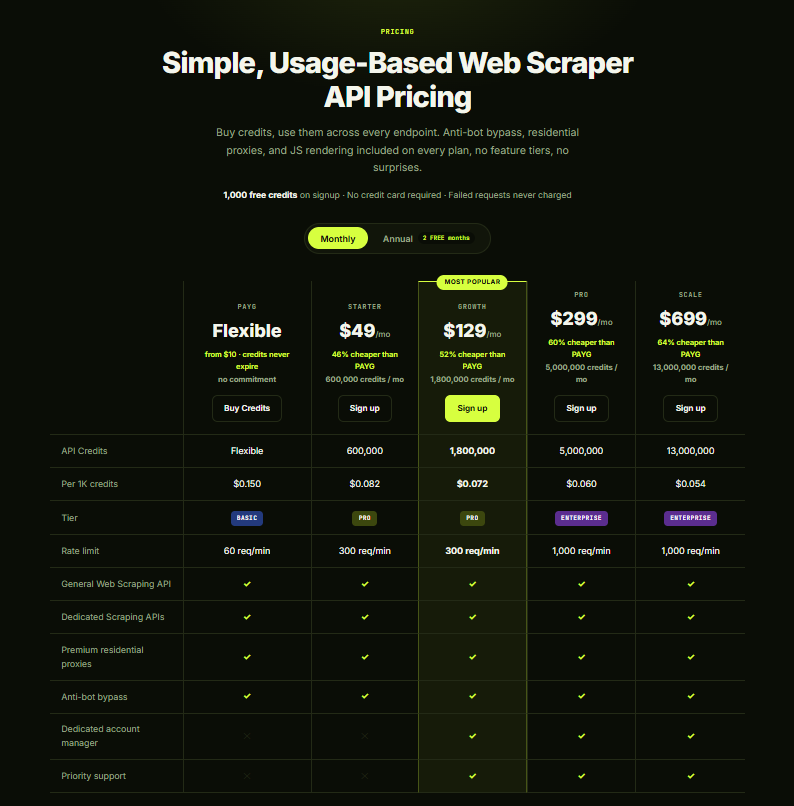
Pricing: pay-as-you-go from $10 at $0.15 per 1,000 credits, and those credits never expire. Starter is $49 a month for 600,000 credits and Growth is $129 for 1.8 million, with two months free on annual billing. A plain page costs 2 credits, a browser render 6, a browser render through a premium proxy 13. That's about $0.16, $0.49 and $1.06 per 1,000 pages on Starter. Failed requests, blocks and empty responses cost nothing. See the full pricing table.
Pros: cheap on JS-heavy pages, a hosted MCP server with 344 tools, non-expiring PAYG. Cons: no SOC 2 claim yet, no crawl endpoint in the docs, and a small review base (4.6 on Trustpilot from 24 reviews).
2. Zyte API: Best for the hardest targets
Zyte prices by how hard a site is to scrape, not by credits. Easy sites sit in tier 1, the toughest in tier 5, and you pay only for successful responses.
- AI extraction for products, articles and job listings
- Ranked first in Proxyway's 2025 benchmark
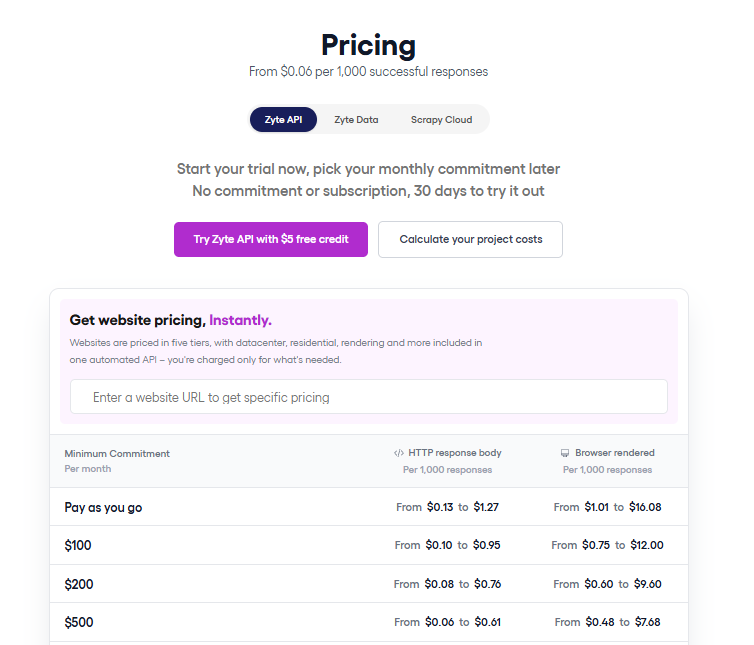
Pricing: on pay-as-you-go, HTTP requests run $0.13 to $1.27 per 1,000 and browser requests $1.01 to $16.08, depending on the tier (Zyte pricing). New accounts get a $5 credit, and the hosted MCP server is billed at normal API rates.
Pros: top independent success ranking; failures and rate-limited responses are free. Cons: you can't predict a site's tier until you try it, and browser rendering on tier 5 sites is the priciest option here.
3. Bright Data Web Unlocker: Best for enterprise compliance and scale
Bright Data is the heavyweight. Web Unlocker is one flat rate: $1.50 per 1,000 successful requests on pay-as-you-go, rendering included, with unlimited concurrency (pricing).
- MCP server, remote or local
- SOC 2 Type II, ISO 27001 and CSA STAR Level 1
- 5,000 free requests every month
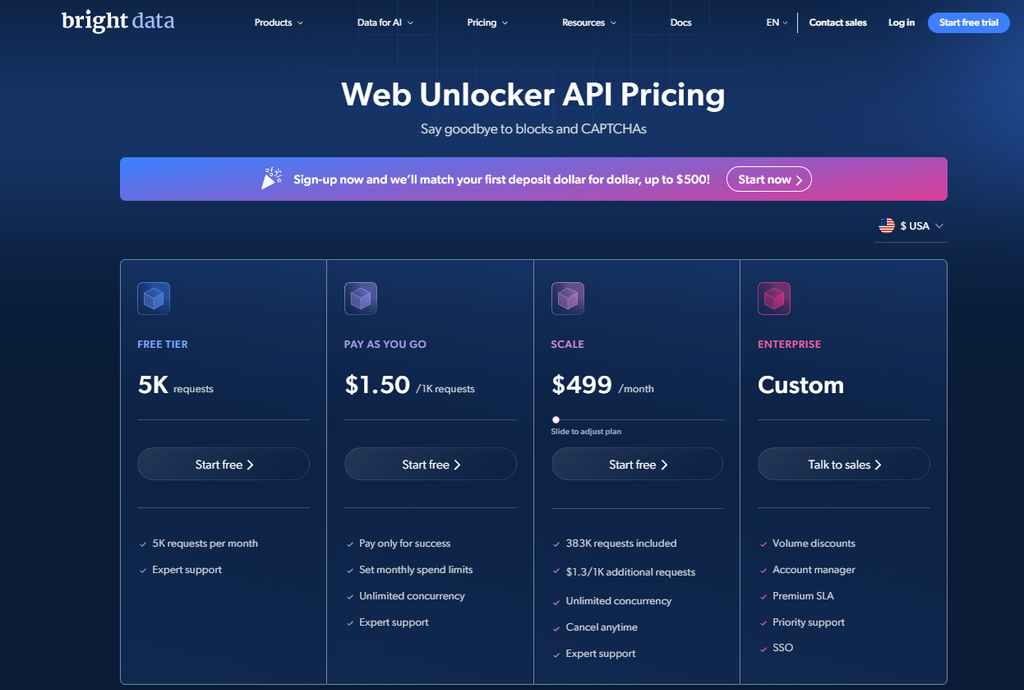
Pricing: $1.50 per 1,000 on PAYG; the Scale plan is $499 a month. Premium domains cost more, and the rate isn't published.
Pros: the compliance paperwork big companies ask for, no concurrency ceiling, one predictable rate. Cons: $1.50 is steep for plain HTML pages that cost $0.15 to $0.25 elsewhere.
4. Oxylabs: Best for e-commerce and search at volume
Oxylabs sells results, not credits, with separate rates for targets like Google and Amazon. It owns ScrapingBee too, which is good to know when you compare the two.
- SOC 2 Type II and ISO 27001
- Dedicated scrapers for Google, Amazon, Walmart and AI answer engines
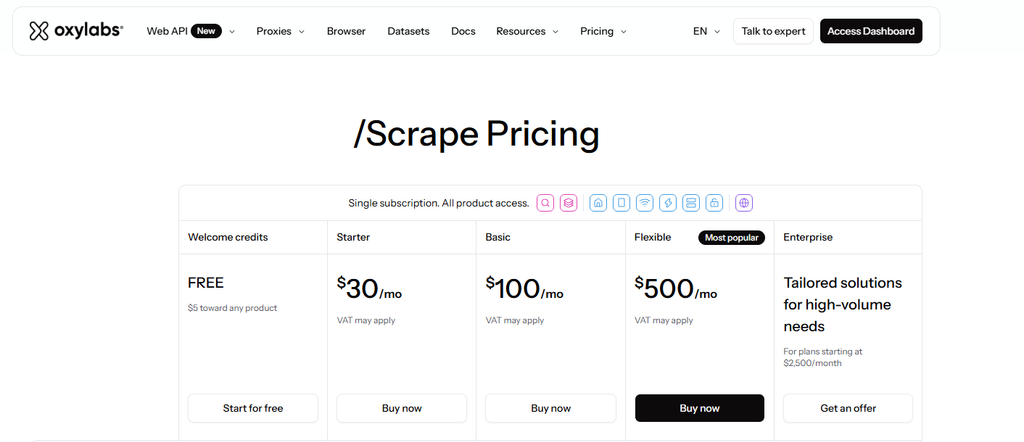
Pricing: Starter is $30 a month. Its /Scrape endpoint and Amazon start at $0.50 per 1,000 results; a custom domain costs $1.00 per 1,000, or $1.50 with JavaScript. On the $100 Basic plan those drop to $0.45, $0.90 and $1.40. AI parsing adds $3.00 per 1,000 pages.
Pros: strong target-specific scrapers and enterprise compliance. Cons: the pricing page doesn't make it obvious which rate applies to a generic URL. Check before you commit.
5. Decodo: Best for protected JavaScript pages on a small plan
Decodo, formerly Smartproxy, publishes plain per-1,000 rates instead of credit math. On its $19 plan, a JavaScript page through a premium proxy costs $1.50 per 1,000 (pricing). That's among the lowest protected-page rates we found, and the lowest on a $19 plan.
- Paid plans come with a 14-day money-back option
- 100+ pre-built templates, including Google, Amazon and TikTok
- ISO/IEC 27001:2022
- You only pay for successful requests
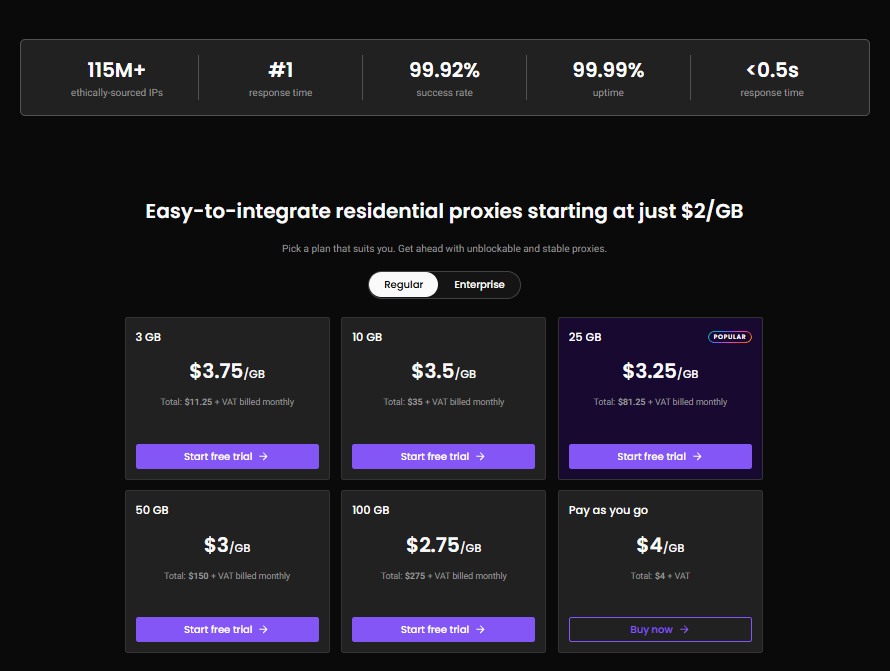
Pricing: $0.50 standard, $0.75 with JS, $1.00 premium, $1.50 premium with JS, all per 1,000 on the $19 plan.
Pros: cheap protected pages, prices you can read without a calculator. Cons: the default proxy pool is premium, so a request that doesn't set it pays the premium rate. Set it on purpose.
6. Scrapfly: Best for low entry cost with compliance
Scrapfly charges just $0.15 per 1,000 plain HTML pages on its $30 Discovery plan, one of the lowest rates here. JavaScript rendering adds 5 credits, so a rendered page lands at $0.90 per 1,000.
- Residential proxies at 25 credits per request
- SOC 2 Type II, ISO 27001, HIPAA and GDPR
- Hosted, open-source MCP server
- Failed scrapes aren't billed, unless 30% or more of your last 24 hours of scrapes get blocked
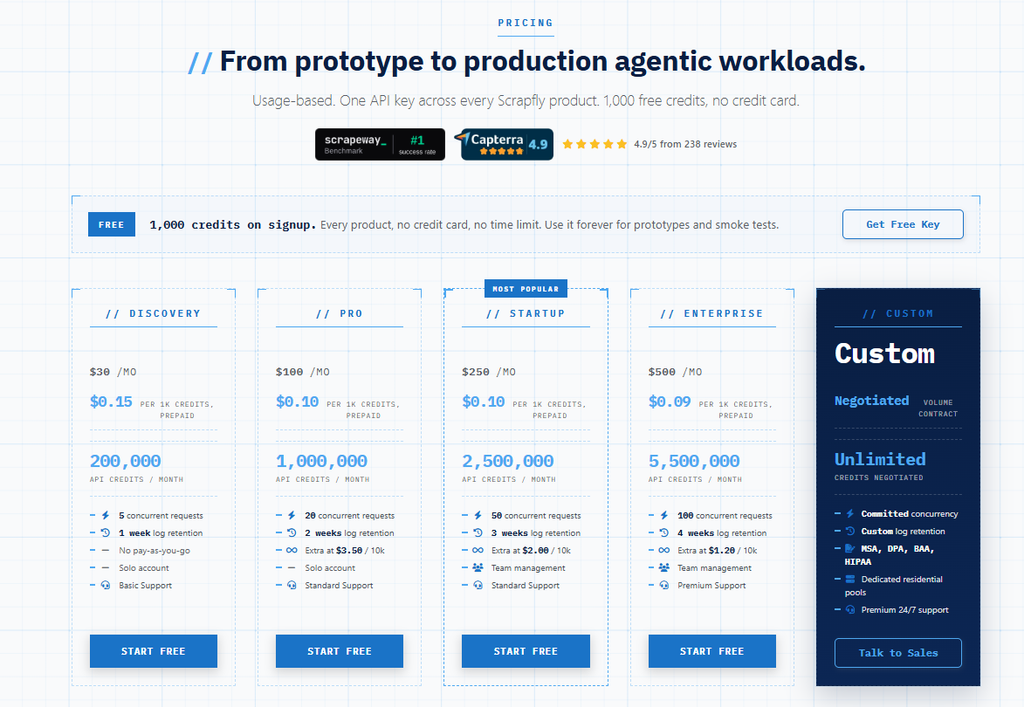
Pricing: Discovery $30 for 200,000 credits; Pro $100 for 1 million.
Pros: very low HTML and JS costs, strong compliance list. Cons: its anti-bot surcharge varies per request, and its own pages disagree on how much (billing docs). Watch the cost fields in its API responses early on. Compare it with us on the Scrapfly alternative page
7. ScrapingBee: Best for browser control and JS scenarios
ScrapingBee lets you click, scroll and type before the page is captured, which helps on flows that need interaction. It's now part of the Oxylabs group but still runs as its own product.
- JavaScript scenarios, screenshots, CSS and AI extraction
- Hosted MCP server with 18 tools
- Dedicated Google, Amazon and Walmart APIs
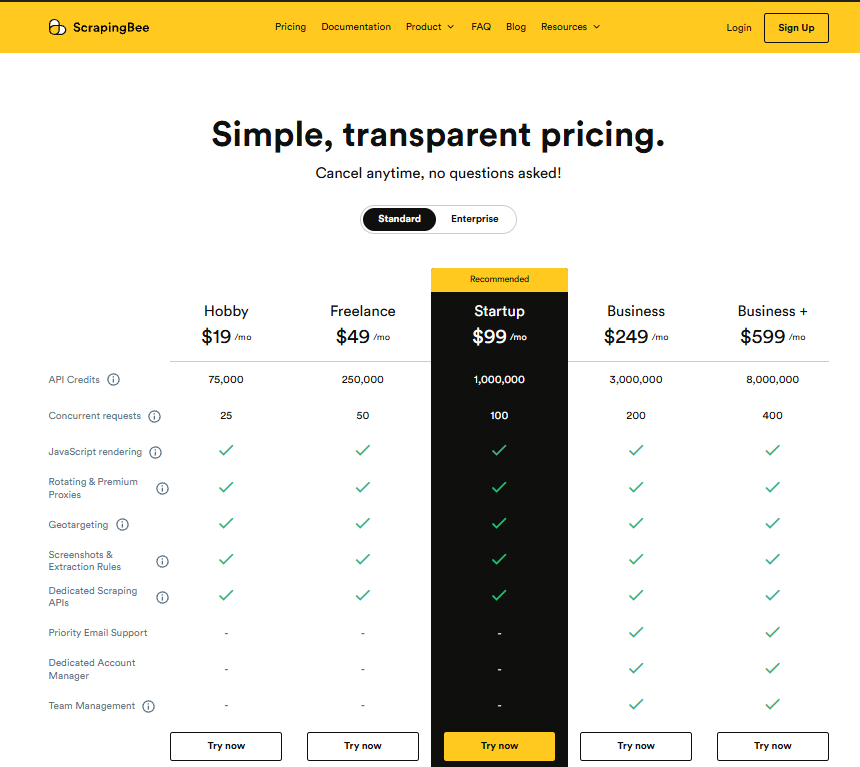
Pricing: Hobby is $19 for 75,000 credits; Startup is $99 for 1 million. JavaScript rendering is on by default at 5 credits, so turn it off for static pages and you pay 1.
Pros: great browser controls, high review scores (4.9 on Capterra from 141 reviews). Cons: 200, 404 and 410 responses are all billed, and subscription credits don't roll over. More on the ScrapingBee alternative page, or our three-way ScrapingBee vs Scrapingdog vs WebScraperAPI comparison.
8. Scrapingdog: Best for budget SERP and social data
Scrapingdog pairs a general scraping API with a long list of dedicated endpoints for Google, LinkedIn, X, YouTube, Amazon and more.
- Pay-as-you-go from $10 for 25,000 credits, non-expiring
- Local MCP server with 35 tools
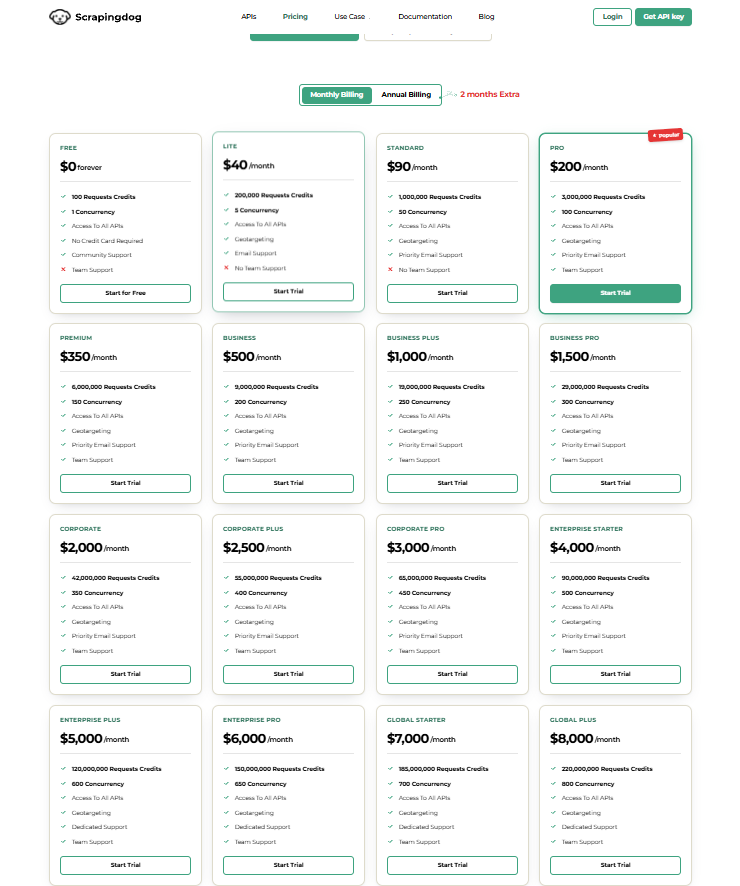
Pricing: Lite is $40 for 200,000 credits, so $0.20 per 1,000 plain pages and $1.00 for JS-rendered ones.
Pros: cheap plain HTML and SERP data, flexible PAYG. Cons: the free tier is just 100 credits, the MCP server runs locally only, and PAYG costs twice the Lite rate. See the Scrapingdog alternative page.
9. ScraperAPI: Best for structured Amazon and Google data
ScraperAPI's structured endpoints return parsed JSON for Amazon, Google, Walmart, eBay and Redfin, so you skip writing parsers.
- Hosted MCP server
- Bot-protection bypass for Cloudflare, DataDome, PerimeterX and Akamai, at 10 extra credits

Pricing: Hobby is $49 for 100,000 credits, and the free plan gives 1,000 credits a month. Rendering costs 10 credits and premium plus rendering 25, so JavaScript pages run $4.90 per 1,000 and protected ones $12.25.
Pros: handy parsed endpoints, a simple API. Cons: the most expensive JS rendering on this list, and 404 responses are billed. Our ScraperAPI comparison has the side-by-side.
10. ZenRows: Best for small monthly budgets
ZenRows starts at $19 and gives you 5,000 free credits every month, no card. JS rendering and premium proxies are per-request options on its Universal Scraper API.
- Hosted or local MCP server
- SOC 2 and ISO 27001, listed on the Enterprise plan

Pricing: Build starts at $19 for 45,000 credits. JS costs 5 credits and JS plus premium 25, which works out to $2.11 and $10.56 per 1,000.
Pros: a generous recurring free tier and a low starting price. Cons: protected pages get expensive fast, and 404 and 410 responses count as successful.
Get 1,000 free credits and test WebScraperAPI on your own URLs. Start free, no card required.
What 1,000 pages really cost, side by side
Same formula, every provider, entry plans first.
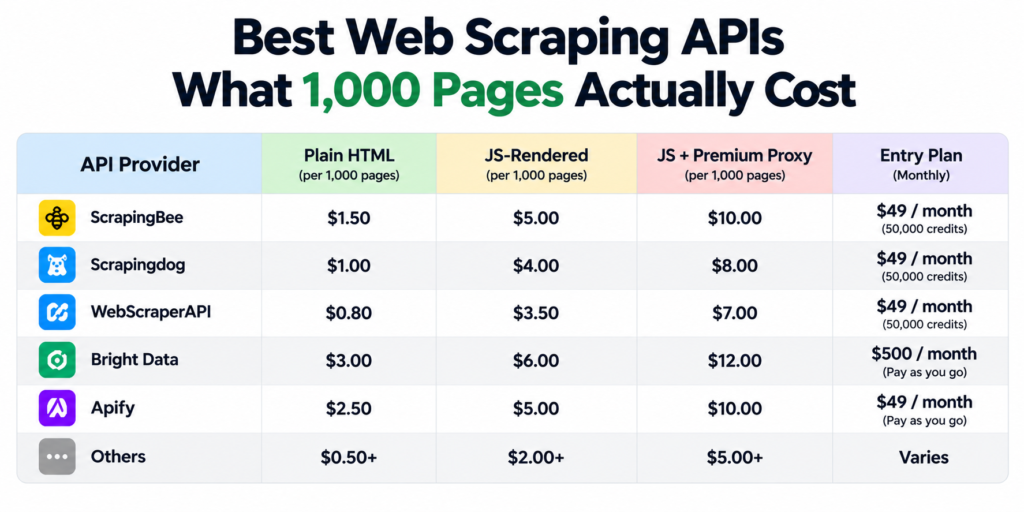
Pricing verified on each provider's own page, October 2026.
Entry plans flatter whoever has the smallest plan, so here's the same math at roughly $100 a month.
| API, ~$100 plan | Plain HTML | JS-rendered | JS + premium proxy |
|---|---|---|---|
| Scrapingdog Standard ($90 / 1M credits) | $0.09 | $0.45 | $2.25 |
| ScrapingBee Startup ($99 / 1M) | $0.10 | $0.50 | $2.48 |
| Scrapfly Pro ($100 / 1M) | $0.10 | $0.60 | $3.00 + anti-bot |
| WebScraperAPI Growth ($129 / 1.8M) | $0.14 | $0.43 | $0.93 |
| ScraperAPI Startup ($149 / 1M) | $0.15 | $1.49 | $3.73 |
| ZenRows Launch ($99 / 500K) | $0.20 | $0.99 | $4.95 |
| Decodo ($99 plan) | $0.30 | $0.60 | $1.10 |
| Oxylabs Basic ($100), custom domain | $0.90 | $1.40 | no separate tier |
| Firecrawl Standard ($99 / 100K) | $0.99 | $0.99 | $0.99 |
Pricing verified on each provider's own page, October 2026. Bright Data stays at $1.50 per 1,000 on pay-as-you-go; Zyte still prices by site tier.
Two things jump out. Plain HTML is cheap almost everywhere once you're past the smallest plan, so it shouldn't drive your choice. The protected-page column is where providers split, from under $1 to about $5 at this tier, and over $12 on the smallest plans.
Bottom line: if most of your targets need a browser and a residential IP, the ranking flips. Price that column first.
Who charges you when a request gets blocked
A blocked request that still costs credits is the quiet budget killer. Here's what each vendor says about it.
| API | What you pay for |
|---|---|
| WebScraperAPI | Successful responses only; blocks, timeouts, errors and empty responses are free |
| Zyte API | Successful responses only |
| Bright Data | Successful requests only |
| Decodo | Successful requests only |
| Scrapingdog | Failed requests never charged |
| ZenRows | Failed requests free, but 404 and 410 count as successful |
| Scrapfly | Failed scrapes free under a fairness policy |
| ScrapingBee | 200, 404 and 410 responses |
| ScraperAPI | 200 and 404 responses |
| Oxylabs | Faulted jobs free; a general rule isn't stated on the pricing page |
Why does a billed 404 matter? Because scraping a product catalog full of dead links can burn real money on pages that return nothing.
Not quite scraping APIs: Firecrawl and Apify
These two show up on a lot of "best web scraping API" lists, and they're good tools. They just solve a different problem.
Firecrawl turns sites into clean Markdown or JSON for LLMs, with crawl, map and search endpoints. It's 1 credit per page with rendering included, but Hobby is $19 for 5,000 credits, so about $3.80 per 1,000 pages. On the $99 Standard plan that falls to $0.99. Pages that return a 403 or 404 are still charged. It's SOC 2 Type II across all plans.
Apify is a platform of ready-made scrapers called Actors, billed in compute units plus proxy traffic. There's $5 of free usage a month, and Starter is $19. Great when someone already built the scraper you need. Harder to price per page.
Pick these when the job is crawling for RAG or AI training data, or reusing a community scraper. Pick a scraping API when you need to fetch specific URLs reliably and know the cost.
How to pick a web scraping API in an afternoon
Start with your main requirement, then shortlist two or three.
| If you mostly need... | Shortlist | Why |
|---|---|---|
| JS-heavy pages at low cost | WebScraperAPI, Decodo, Scrapfly | Lowest JS-rendering costs on entry plans |
| The hardest anti-bot targets | Zyte, Bright Data | Zyte leads Proxyway's test; both bill only successes |
| SOC 2 for a security review | Bright Data, Oxylabs, Scrapfly | Vendor-stated SOC 2 Type II |
| AI agents and MCP | WebScraperAPI, Zyte, ScrapingBee | Hosted MCP servers |
| Irregular usage | WebScraperAPI, Scrapingdog | Non-expiring pay-as-you-go from $10 |
| Parsed Amazon or Google data | ScraperAPI, Oxylabs, Scrapingdog | Dedicated structured endpoints |
Then run a quick test. Honestly, it beats any list, this one included:
- Pick 50 to 100 URLs that look like your real workload, including your hardest targets.
- Run them through each shortlisted API on its free credits (WebScraperAPI gives you 1,000 to start).
- For each provider, record successful pages, credits used and failures you paid for.
- Divide the credits used by the number of successful pages.
- Multiply that by the plan's price per credit.
Lowest cost per successful page wins.
FAQs
What is the best web scraping API?
It depends on your targets. For mixed workloads and AI agents, WebScraperAPI has low JS-rendering costs and a hosted MCP server. Zyte ranked first in Proxyway's 2025 success-rate benchmark for hard targets. Bright Data and Oxylabs suit enterprises that need SOC 2. Test two or three on your own URLs before you buy.
What is the cheapest web scraping API?
For plain HTML, Scrapingdog ($0.09 per 1,000 on its $90 plan), ScrapingBee and Scrapfly ($0.10 at about $100) are the lowest we found. For JavaScript pages behind premium proxies, WebScraperAPI ($0.93 to $1.06), Decodo ($1.10 to $1.50) and Firecrawl ($0.99 on Standard) beat credit-multiplier plans that reach $10 to $12 per 1,000.
Do web scraping APIs charge for failed requests?
Most don't bill blocks or server errors, but the fine print differs. ScrapingBee bills 200, 404 and 410 responses, ScraperAPI 200 and 404, Firecrawl 403 and 404 pages. WebScraperAPI, Zyte, Decodo and Scrapingdog bill successes only.
Which web scraping API has the highest success rate?
In Proxyway's 2025 report, which tested 11 providers on 15 protected sites, Zyte ranked first. Success rates change by target and month, and many providers weren't tested, including WebScraperAPI. Be careful with vendor-run benchmarks that crown their own product; several top-ranking lists borrow a rival's test or skip the method entirely. The reliable answer is your own test: run the same URLs through each API and count usable pages.
Can a web scraping API bypass Cloudflare?
Often, yes, but no provider guarantees it for every site. Getting past Cloudflare usually takes real browser rendering plus residential IPs, which is exactly where credit multipliers kick in. Our FAQ on whether Cloudflare prevents scraping explains what it checks, and how websites detect scraping covers the other signals.
What is the difference between a proxy and a web scraping API?
A proxy only changes the IP your request comes from. A scraping API bundles the rest: proxy rotation, browser rendering, anti-bot handling, retries and often parsed output. You pay more per request and skip building that stack.
Which web scraping API works best with AI agents and MCP?
Look for a hosted MCP server with OAuth, so an agent can call it without you copying keys around. WebScraperAPI, Zyte, Bright Data, ScrapingBee, Scrapfly, ScraperAPI and ZenRows all offer hosted servers. WebScraperAPI's covers 344 tools across 31 products, from general scraping to Google, Amazon and Reddit, with setup guides for Claude and Cursor.