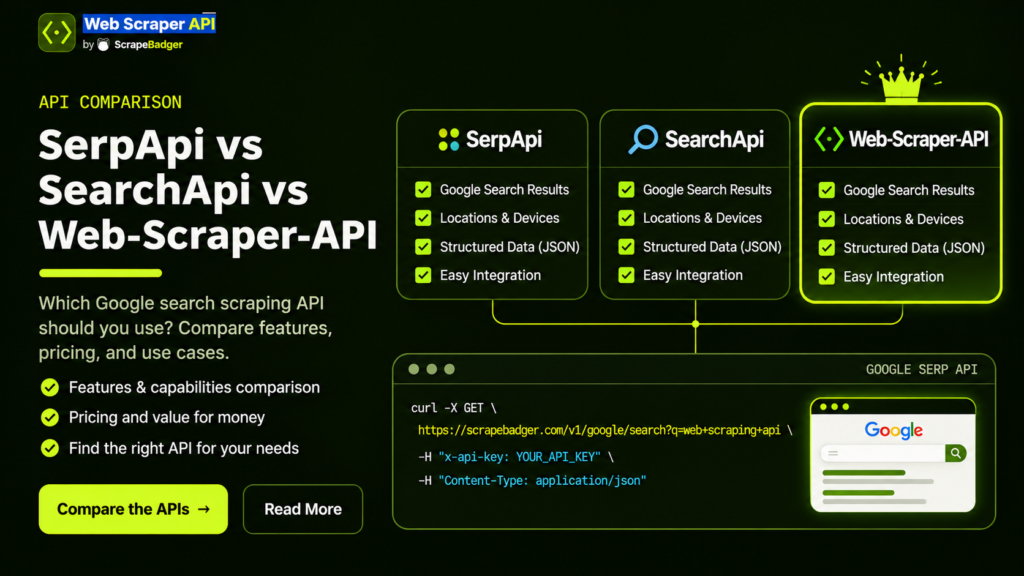
Weighing SerpApi vs SearchApi? SerpApi is the name everyone knows. SearchApi looks like the same product for a fraction of the price. So which one belongs behind your rank tracker, AI agent or price monitor, and is there a cheaper third option?
We compared both on price per 1,000 Google searches, what one billed search actually covers, result types (organic, local, shopping, AI Overview), speed and legal cover. Then we added our own web scraper API as a third column. Every price comes from the provider's own pricing page. Full disclosure: Web-Scraper-API is our product, so we've spelled out where it loses too.
Quick answer
- SearchApi if you want SerpApi-style JSON for Google at 2.5x to 6x less per search, with a $2M legal guarantee from $100 a month.
- SerpApi if you need 80+ engines (Bing, Baidu, Yandex, Naver, marketplaces), the most established docs, or a legal shield, and the bill isn't your main constraint.
- Web-Scraper-API if Google is all you need, you want the lowest cost per search up to 650,000 searches a month, or you also need to scrape the pages behind the results.
| Best for | Many engines, mature tooling | Cheaper SerpApi-style Google data | Lowest cost per Google search, plus page scraping |
| Free tier | 250 searches/month | 100 requests | 1,000 credits (50 Google searches) |
| Entry plan | $25 for 1,000 searches | $40 for 10,000 searches | $49 for 600,000 credits (30,000 searches) |
| Cost per 1,000 searches, mid plan | $10.00 | $2.86 | $1.43 |
| Legal cover | U.S. Legal Shield from $150/month | Up to $2M from $100/month | None |
| Search engines | 80+ APIs | ~75 APIs listed | Google only |
Who's behind each, and why two of them are in court
SerpApi is the incumbent. Julien Khaleghy founded it in 2017 in Austin, Texas. SearchApi came later, and according to SerpApi's own complaint, its founder Zilvinas Kucinskas used to work as a software contractor for SerpApi. Web-Scraper-API is the general web scraping API powered by ScrapeBadger, with 40+ Google endpoints on the same credit balance.
Two lawsuits are worth knowing about before you sign anything.
Google v. SerpApi. Google sued SerpApi in December 2025 under the DMCA's anti-circumvention rules. On 20 July 2026 the court dismissed the original complaint, part of it without leave to amend. Google filed an amended complaint on 10 August. SerpApi moved to dismiss again, briefing closed on 29 September, and the court vacated the hearing to decide on the papers. No ruling had appeared on the docket by early November. SerpApi says its service hasn't changed for customers.
SerpApi v. SearchApi. In January 2026 SerpApi sued SearchApi and Kucinskas in the Western District of Texas, alleging he took source code and trade secrets. SearchApi moved to dismiss in April and says the suit followed its refusal to sell to SerpApi in December 2025. Those are allegations from both sides. No court has ruled.
Does any of this change the JSON you get today? No. But procurement will ask.
Bottom line: two SERP specialists, both in active litigation, and a general scraping API with a Google suite on the side. Read the dockets, not the press releases.
Price per 1,000 Google searches, at the same monthly budget
Nobody buys "1,000 searches". You buy a plan. So here's what roughly the same monthly spend gets you.
| Monthly budget | SerpApi | SearchApi | Web-Scraper-API |
|---|---|---|---|
| $25 to $50 | Starter, $25: 1,000 searches | Developer, $40: 10,000 | Starter, $49: 30,000 |
| $100 to $150 | Production, $150: 15,000 | Production, $100: 35,000 | Growth, $129: 90,000 |
| $250 to $300 | Big Data, $275: 30,000 | BigData, $250: 100,000 | Pro, $299: 250,000 |
| $500 to $725 | Searcher, $725: 100,000 | Scale, $500: 250,000 | Scale, $699: 650,000 |
Pricing verified on each provider's own page, November 2026.
SerpApi and SearchApi sell searches. Web-Scraper-API sells credits, and a full Google search costs 20 of them. So a plan's search count is its credits divided by 20: Starter's 600,000 credits / 20 = 30,000 searches.
Per 1,000 searches, that works out to:
| Plan level | SerpApi | SearchApi | Web-Scraper-API |
|---|---|---|---|
| Entry | $25.00 | $4.00 | $1.63 |
| Mid | $10.00 (Production) | $2.86 (Production) | $1.43 (Growth) |
| Around 500,000 searches/month | $5.50 (Infrastructure) | $1.80 (Octo 500K) | $1.08 (Scale, 650K) |
Formula: plan price / searches in the plan x 1,000. For us: plan price / plan credits x 20 x 1,000. Pay-as-you-go with no subscription costs $3.00 per 1,000.
Now the part we'd rather skip. Our largest self-serve plan stops at 13M credits, which is 650,000 searches. Past that you need a custom contract. SearchApi publishes plans up to 5M searches at $1.00 per 1,000, and SerpApi's Cloud plans run from $3.75 per 1,000 at 1M searches down to about $1.96 at 54M. Running millions of searches a month and want a list price? SearchApi wins.
One more multiplier. SerpApi's speed tiers multiply the plan price: Ludicrous Speed doubles it and Ludicrous Speed Max quadruples it. SearchApi lists a standard and a faster option on every plan but doesn't print the faster one's price on its pricing page.
Try it on your own keywords: 1,000 free credits cover 50 full Google searches. No card needed. Start free
Bottom line: at every budget up to about $700 a month, Web-Scraper-API returns the most Google searches. SearchApi comes second at roughly 1.7x to 2.5x our cost per search, and SerpApi costs roughly 5x to 15x more. Above 650,000 searches a month, SearchApi's published ladder is the better deal.
What one "search" actually buys
Here's the trap. The three tools don't count the same thing as one search, so per-1,000 rates only tell half the story.
AI Overviews can cost two searches. For some queries Google loads the AI Overview after the main results. When that happens, SerpApi returns a short-lived page_token and you call its google_ai_overview engine for the full text. SerpApi's own blog says the pair "will count as two SerpApi searches." SearchApi uses the same token pattern through an engine with the same name, and its pricing page doesn't say how the second call is billed.
On Web-Scraper-API you set ai_overview=true and the deferred overview gets fetched and merged into the same response. Our API reference says that adds nothing and our product page says it adds one credit, so we quote the higher figure: 21 credits, or $1.72 per 1,000 on Starter.
Say 40% of your queries need the follow-up (a hypothetical). Your SerpApi search count rises 40%. Check your own keyword set before trusting any per-1,000 rate, ours included.
Repeats can be free. SerpApi's JavaScript library documents a one-hour cache. Identical queries inside that window come from cache and don't count, unless you set no_cache=true. Web-Scraper-API doesn't charge for cached responses either. SearchApi's pricing page doesn't mention caching at all. Is that a big deal? For a rank tracker re-checking the same keyword several times an hour, yes. For an AI agent firing one-off questions, barely.
Empty results still count on SerpApi. Its pricing page says a response with 100 results and an empty result set each count as one search. SearchApi charges only for responses with a 200 status code. We charge 0 credits for failed requests.
Light modes. Only need positions? Our Light Search endpoint returns organic results and related searches for 10 credits, half the full price. That brings Starter down to $0.82 per 1,000. SerpApi also has a Google Light API, pitched on speed.
Depth costs the same everywhere. Google dropped the num=100 parameter in September 2025, so a top-100 check now means ten results pages. Ten requests on any of the three: 10 SerpApi searches, 10 SearchApi searches, or 200 of our credits.
Bottom line: compare cost per finished result, not per call. AI Overview follow-ups and caching can move a real bill more than the gap between two plans.
Result types: organic, local, shopping and AI Overview
On an ordinary Google results page, all three return the blocks most teams need.
| Result type | SerpApi | SearchApi | Web-Scraper-API |
|---|---|---|---|
| Organic, ads, People Also Ask, knowledge graph | Yes | Yes | Yes |
| Local pack | Yes | Yes | Yes |
| Inline shopping results | Yes | Yes | Yes |
| AI Overview | Yes, sometimes two calls | Yes, sometimes two calls | Yes, one call |
| Dedicated Shopping endpoint | Google Shopping, Immersive Product | Google Shopping | Shopping search, 20 credits |
| Google Maps endpoint | Yes | Yes | Yes |
| Google AI Mode | Yes | Yes | Yes, 20 credits |
The differences live in the details. In SerpApi's own side-by-side test, SearchApi matched it on local results and inline shopping but returned related searches as plain text where SerpApi parsed them. That's a vendor grading itself, so weigh it accordingly. Our full search endpoint takes 185 Google domains, city-level location, uule, device, tbs and safe search, which covers most local SEO setups.
One caveat applies to everyone. Google doesn't show an AI Overview for every query or in every country, so that field will sometimes come back empty whichever API you use.
Bottom line: for organic, local, shopping and AI Overview data, any of the three will do the job. Decide on price, billing rules and the engines you need beyond Google.
Speed: what the published tests say
No independent benchmark runs all three on the same queries. What exists is vendor-run, and the numbers don't agree.
| Published test | SerpApi | SearchApi |
|---|---|---|
| Scrapingdog, Jan 2026 (Search / Shopping) | 3.34s / 7.20s | 4.55s / 3.67s |
| Scrapingdog's best SERP APIs list | 5.49s | 2.96s |
| Scrape.do, 25 queries, updated Aug 2026 | 1.96s | Not tested |
Same SerpApi endpoint, anywhere from 1.96 to 5.49 seconds. That's normal: Google latency swings with query type, location and time of day. Every one of these tests also comes from a company selling a competing API. (A test from us would carry the same bias.)
We haven't published a speed figure for our own Google endpoint, so we won't quote one here. If latency decides it for you, push 30 to 40 of your real queries through each free tier. Run them one at a time, then with a little concurrency, and compare median and p95 times, not averages. And if you need SerpApi faster, its Ludicrous Speed tier averages 2.2x quicker at twice the price.
Bottom line: all three land in the low single-digit seconds in published tests. Test with your own queries. Someone else's average won't tell you much.
Limits, failed requests and legal cover
Hourly caps catch people out. SerpApi limits throughput to 20% of your plan volume per hour on plans under 1M searches, so its Starter plan tops out at 200 searches an hour. SearchApi uses the same 20% rule. Web-Scraper-API limits by the minute instead: 60 requests per minute on pay-as-you-go, 300 on Starter and Growth, 1,000 on Pro and Scale. Running a nightly batch of 10,000 keywords? That difference matters more than price.
Free tiers: SerpApi gives 250 searches every month, SearchApi 100 requests with no card, Web-Scraper-API 1,000 credits (50 full searches) with no card. All three subscriptions are monthly allowances. Our pay-as-you-go credits are the exception: they never expire.
Legal cover is where both competitors beat us. SerpApi includes its U.S. Legal Shield from the $150 Production plan up. SearchApi offers a Legal Protection Guarantee backed by up to $2M in coverage from its $100 Production plan, and says it doesn't cover how you use the data. Web-Scraper-API offers neither. If your legal team requires indemnity from the data vendor, that settles it.
Bottom line: check the hourly cap against your batch size. And if indemnity is a hard requirement, shortlist SerpApi and SearchApi only.
Beyond Google
SerpApi has the widest catalog: 80+ search APIs on its own comparison page, including Bing, Baidu, Yandex, Naver, DuckDuckGo, Amazon, Walmart and YouTube. SearchApi's site lists around 75 APIs, with Bing, Yandex, Amazon and TikTok among them. Web-Scraper-API's search endpoints cover Google only, though that's 40+ endpoints across Search, Maps, News, Shopping, Trends, Scholar, Flights and AI Mode.
What sits next to the search endpoints is where we differ. The same API key scrapes any URL, with anti-bot bypass for Cloudflare, DataDome, Akamai and others, JavaScript rendering, and residential proxies in 150+ countries. A request costs 3 credits over HTTP, 7 with a browser, and 13 or 17 through a premium proxy. So you can pull a SERP, then scrape the ranking pages behind it, on one bill. Building an agent? The same tools are exposed through our MCP server.
SerpApi has narrowed that gap, to be fair. In October 2026 it launched an Extract API that fetches any public page as JSON, Markdown or HTML, priced like a search. Reporting on the launch notes that pages built with client-side JavaScript may return little more than their shell. Test it on the sites you actually care about.
Bottom line: need Bing, Baidu or marketplaces? SerpApi or SearchApi. Need Google plus the pages behind the results, protected ones included? Web-Scraper-API.
Which one fits which job
| If you need... | Pick |
|---|---|
| Lowest cost per Google search, up to 650K a month | Web-Scraper-API |
| Positions only, as cheap as possible | Web-Scraper-API Light Search (10 credits) |
| Millions of Google searches a month at a list price | SearchApi (Octo plans) |
| AI Overviews at volume without a second call | Web-Scraper-API |
| Bing, Baidu, Yandex, Naver or marketplace APIs | SerpApi |
| Vendor indemnity for procurement | SerpApi or SearchApi, Production plan and up |
| Lowest latency, flexible budget | SerpApi with Ludicrous Speed (test first) |
| Search results plus scraping the result pages | Web-Scraper-API |
| A rank tracker re-checking keywords within the hour | SerpApi's free cache or ours, compared on your data |
No single winner. Really. The right pick depends on how many engines you need, how many searches you run, and whether legal needs a signed guarantee.
FAQ
Which is better, SerpApi or SearchApi?
For Google-only work, SearchApi returns similar data for 2.5x to 6x less per search and adds a $2M legal guarantee from $100 a month. SerpApi is the better pick if you need its catalog of 80+ engines, its paid speed tiers, or the most established docs and tooling. Both cap hourly use at 20% of the plan.
Is SearchApi cheaper than SerpApi?
Yes, at every published tier. SearchApi's Production plan is $100 for 35,000 searches ($2.86 per 1,000), while SerpApi's Production plan is $150 for 15,000 ($10.00 per 1,000). At entry level it's $4.00 against $25.00 per 1,000. For Google, Web-Scraper-API is cheaper again at $1.43 per 1,000 on its $129 Growth plan.
Does SerpApi charge extra for AI Overviews?
Sometimes. When Google defers the AI Overview, SerpApi returns a page token and you make a second call to its AI Overview API, which SerpApi says counts as two searches. When the overview arrives in the first response, there's no extra charge. Web-Scraper-API fetches a deferred overview inside the same call.
Do failed searches count against my quota?
No. SerpApi doesn't count cached, errored or failed searches (a successful search with zero results still counts). SearchApi charges only for 200 responses. Web-Scraper-API charges 0 credits for failures.
Is Google still suing SerpApi?
Yes. A court dismissed Google's original complaint in July 2026, Google filed an amended complaint in August, and SerpApi's second motion to dismiss was fully briefed by late September. No ruling had been published by early November 2026. SerpApi says its service is unchanged.
Can I use a general web scraping API instead of SerpApi for Google results?
Yes, if it has parsed Google endpoints. Point a generic scrape endpoint at google.com and you get raw HTML that you then have to parse, and keep parsing every time Google changes its layout. Web-Scraper-API has dedicated Google endpoints that return structured JSON, plus a general scrape endpoint for every other site, so search and page scraping run on one key and one bill.
Appendix: claims ledger
All 31 claims are sourced; 6 rest on a weaker source and are marked "with caveat". Checked 2 Nov 2026.
| # | Claim as written | Type | Source | Status |
|---|---|---|---|---|
| 1 | SerpApi plans: Free 250/mo; Starter $25/1,000; Developer $75/5,000; Production $150/15,000; Big Data $275/30,000; Searcher $725/100,000; Infrastructure $2,750/500,000 | Pricing | serpapi.com/pricing | Verified |
| 2 | SerpApi Cloud $3,750 at 1M to $106,050 at 54M ($1.96/1K) | Pricing | Same | Verified |
| 3 | Ludicrous Speed 2x price, Max 4x; Ludicrous avg 2.2x faster | Pricing | Same + serpapi.com/ludicrous-speed | Verified |
| 4 | SerpApi throughput 20% of plan/hour under 1M; Starter 200/hr | Policy | Pricing page + plan table | Verified |
| 5 | Empty result set counts as 1 search; cached/errored/failed not counted | Policy | serpapi.com/pricing | Verified |
| 6 | U.S. Legal Shield from Production ($150) up | Policy | serpapi.com/pricing (SerpApi blog says "all recurring except developer") | Verified with caveat |
| 7 | AI Overview follow-up "will count as two SerpApi searches" | Policy | SerpApi blog | Verified |
| 8 | One-hour free cache, no_cache=true | Policy | SerpApi JS library type docs (deno.land) | Verified with caveat: confirm on serpapi.com/search-api |
| 9 | SerpApi has a Google Light API, pitched on speed | Feature | SerpApi blog nav and comparison post | Verified |
| 10 | 80+ search APIs incl. Bing, Baidu, Yandex, Naver, DuckDuckGo, Amazon, Walmart, YouTube | Feature | SerpApi comparison post + its API nav | Verified |
| 11 | SearchApi matched on local + inline shopping; related searches as text | Feature | Same SerpApi test | Verified (vendor's own test, labeled) |
| 12 | Extract API, Oct 2026, priced like a search; JS-heavy pages may return a shell | Company fact | PPC Land | Verified with caveat: press report |
| 13 | Founded 2017 by Julien Khaleghy, Austin | Company fact | PPC Land; SerpApi blog | Verified |
| 14 | SearchApi plans: Developer $40/10,000; Production $100/35,000; BigData $250/100,000; Scale $500/250,000; Octo 500K $900; Octo 5M $5,000 | Pricing | searchapi.io/pricing | Verified |
| 15 | SearchApi 20% of plan credits per hour | Policy | Same | Verified |
| 16 | Only 200 responses charged | Policy | Same | Verified |
| 17 | Legal Protection Guarantee up to $2M, Production+, excludes your use of data | Policy | Same | Verified |
| 18 | Standard + faster speed option, faster price not shown | Pricing | Same | Verified |
| 19 | 100 free requests, no card | Pricing | Same + homepage | Verified |
| 20 | ~75 APIs listed incl. Bing, Yandex, Amazon, TikTok | Feature | searchapi.io homepage nav (our count) | Verified with caveat: approximate count |
| 21 | Same google_ai_overview token pattern | Feature | Third-party API catalog + searchapi-ruby gem docs | Verified with caveat: confirm in searchapi.io/docs |
| 22 | Google v. SerpApi timeline to vacated hearing; no ruling by early Nov | Legal | CourtListener docket, SerpApi blog | Verified; re-check day before publish |
| 23 | SerpApi v. SearchApi: filed Jan 2026 W.D. Tex.; MTD Apr 2026; refused-acquisition claim | Legal | SerpApi blog; PPC Land | Verified; re-check day before publish |
| 24 | Our plans: Starter $49/600K, Growth $129/1.8M, Pro $299/5M, Scale $699/13M, PAYG $0.150/1K | Pricing | Live /pricing (register, confirmed 30 Oct) | Verified |
| 25 | Google Search 20 credits; Light 10; Shopping search 20; AI Mode 20 | Pricing | API reference (register) + Light, Shopping, AI Mode pages | Verified |
| 26 | AI Overview +1 credit (21) | Pricing | Product page vs API ref conflict | Verified with caveat: conservative reading |
| 27 | Cached and failed requests 0 credits; X-Credits-Used header | Policy | API reference (register) | Verified |
| 28 | Rate limits 60 / 300 / 1,000 per minute | Policy | Fact sheet / pricing | Verified |
| 29 | 185 Google domains, location, uule, device, tbs, safe | Feature | API reference (register, 30 Oct) | Verified |
| 30 | Scrape costs 3/7/13/17; anti-bot vendors; 150+ countries | Pricing/feature | Announcements page (register) | Verified |
| 31 | Speed figures 3.34/7.20, 4.55/3.67, 5.49, 2.96, 1.96 | Benchmark | Scrapingdog (two posts), Scrape.do | Verified as published; v |
So, which one?
Want a quick rule? Pick SerpApi when engine breadth or indemnity matters more than price. SearchApi fits when you want SerpApi-style data cheaply at very high volume. And Web-Scraper-API is the call when Google is the job and cost per search is the number that decides it. All three have free tiers, so run 40 of your own queries through each before you commit. Start with 1,000 free credits.