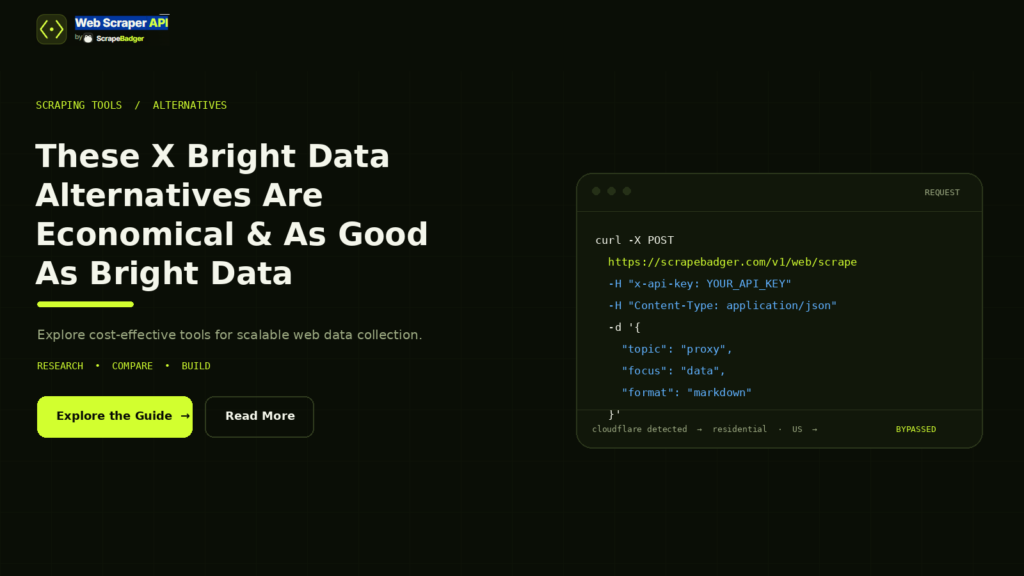
Bright Data works. That's rarely the problem. The problem is the bill, the new identity check for residential proxies, or the fact that a plain product page costs exactly as much as one hidden behind DataDome.
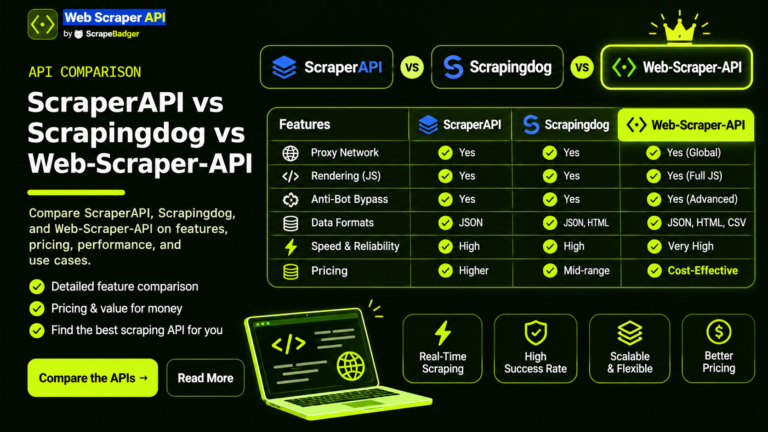
So we priced nine Bright Data alternatives on two jobs: a static page, and a protected page that needs JavaScript rendering plus residential IPs. Each one is a web scraping API or close to it, every price comes from the vendor's own page, and the formula sits next to every number.
Quick answer: the best Bright Data alternatives at a glance
If most of your pages are easy, nearly every credit-based API below beats Bright Data's flat $1.50 per 1,000. If most of them are hard, very few do. Oxylabs and Decodo match Bright Data at $1.50 on protected pages, Web-Scraper-API's Starter plan comes in at $1.39, and ScraperAPI, ZenRows and Zyte's upper tiers cost several times more.
| Tool | Best for | Free tier | Entry price | Easy page, per 1K | Protected JS page, per 1K |
|---|---|---|---|---|---|
| Bright Data (baseline) | Breadth and compliance | 5,000 credits/mo, shared | PAYG, no plan needed | $1.50 | $1.50 |
| Web-Scraper-API | Mixed workloads, small budgets | 1,000 credits, no card | $10 PAYG or $49/mo | $0.25 | $1.39 |
| Oxylabs | Like-for-like replacement | $5 credit | $30/mo | $0.50 | $1.50 |
| Decodo | Cheap residential bandwidth | $5 credit, no card | $19/mo | $0.50 | $1.50 |
| Zyte | Hardest targets | $5 credit (first month) | PAYG with spend limit | $0.13 | $8.04 (tier 4) |
| Apify | Ready-made scrapers | $5/mo of usage | $19/mo | Depends on the Actor | Depends on the Actor |
| Firecrawl | AI and LLM pipelines | 1,000 credits/mo | $19/mo | $3.80 | $3.80 |
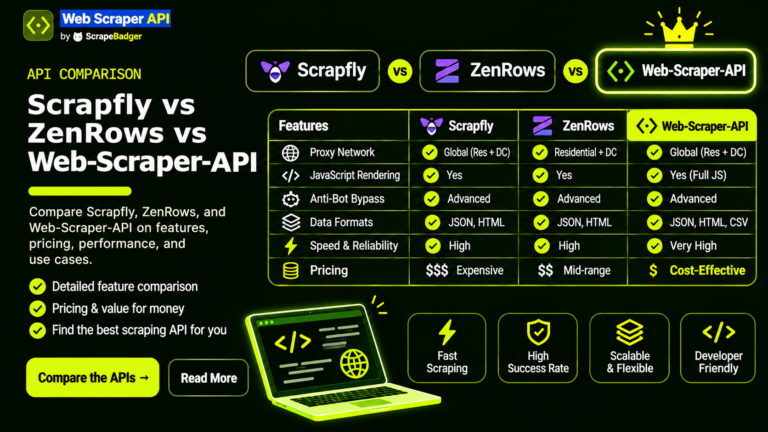
| Scrapfly | Cloud browser plus compliance | 1,000 credits | $30/mo | $0.15 | $4.50 |
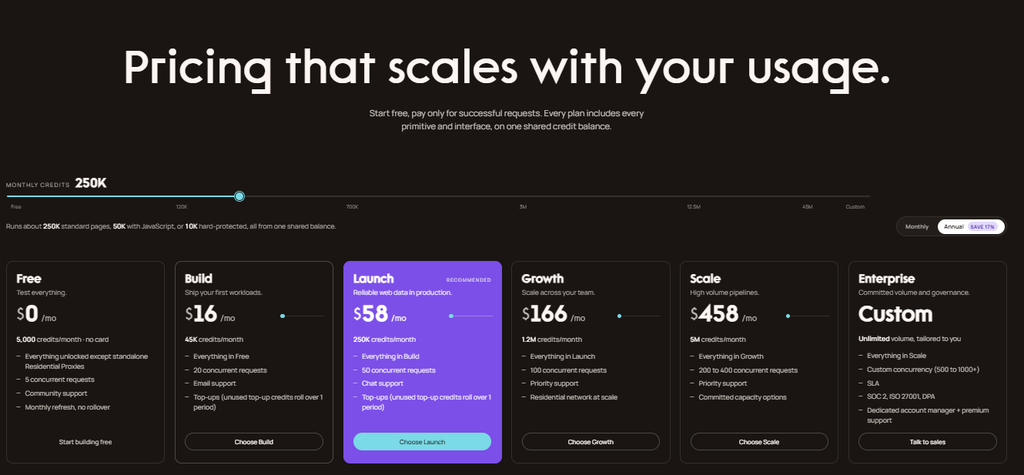
| ZenRows | Free monthly testing | 5,000 credits/mo | $19/mo | $0.42 | $10.56 |
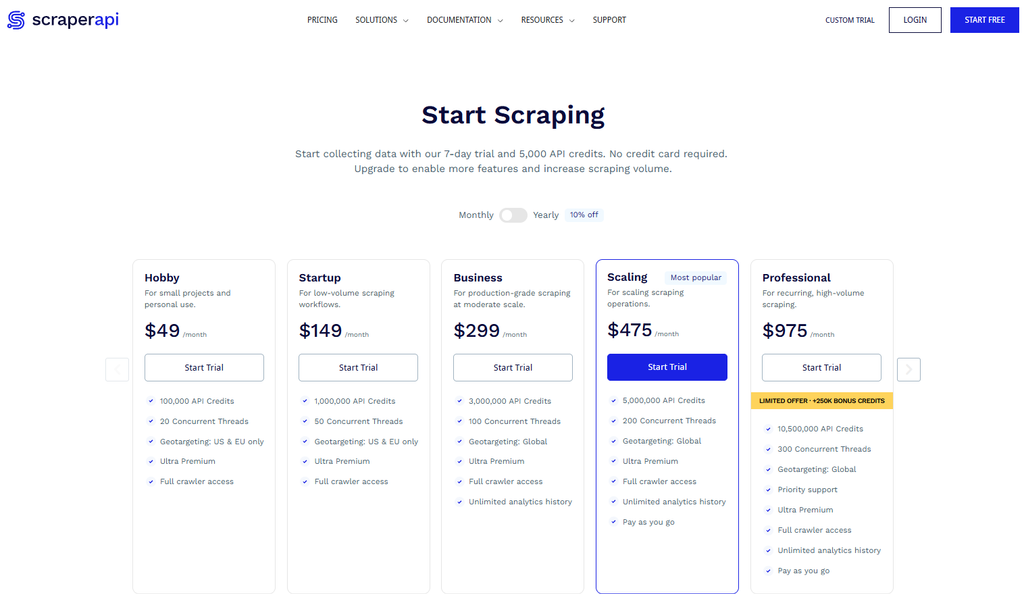
| ScraperAPI | Simplest single endpoint | 5,000 credits for 7 days | $49/mo | $0.49 | $12.25 |
What Bright Data does well
Let's be fair first. Bright Data is the default for a reason, and plenty of teams should stay.
- Breadth. Residential, ISP, datacenter and mobile proxies, an Unlocker API, a SERP API, per-record scrapers, a hosted browser and a dataset marketplace, all under one login.
- Paperwork. SOC 2 Type II, SOC 3 and three ISO certifications (27001, 27017, 27018), per its security overview. The latest SOC 2 report listed there covers June 2024 to May 2025 and is shared under NDA.
- Pay for success. The Unlocker API bills only successful requests in its default setup, and users rate it 4.7 on G2.
If every site you scrape is hardened and your security team wants a SOC 2 report on file, Bright Data is hard to beat. Hold onto that thought.
Why teams look for a Bright Data alternative
Four reasons come up again and again, and every one of them traces back to Bright Data's own pages.
1. Easy pages cost the same as hard ones. The Unlocker API charges $1.50 per 1,000 successful requests on pay-as-you-go, whatever the page. Even the old "premium domains" surcharge is gone for accounts created after 20 May 2026. Great for hard targets. Painful when most of your URLs are plain HTML.
2. Four billing units. Requests (Unlocker, SERP), records (Web Scraper API), gigabytes (Browser API, residential and datacenter bandwidth) and IPs (ISP and datacenter). Forecasting a mixed stack means four meters.
3. Residential access now needs a business check. Since 7 July 2026, new residential zones need funds added first, a corporate email (Gmail and Outlook don't qualify), a company registration document and a use case, followed by a human review, with a status update within 48 hours. Solo developer without a registered company? That's a problem.
4. One setting changes the billing rule. Turn on custom headers, cookies or the "expect" feature in an Unlocker zone, and Bright Data bills 100% of requests, failures included.
Which of these actually bites depends on your stack. If you only run the Unlocker API on default settings, it's mostly number one.
Bright Data pricing in 2026
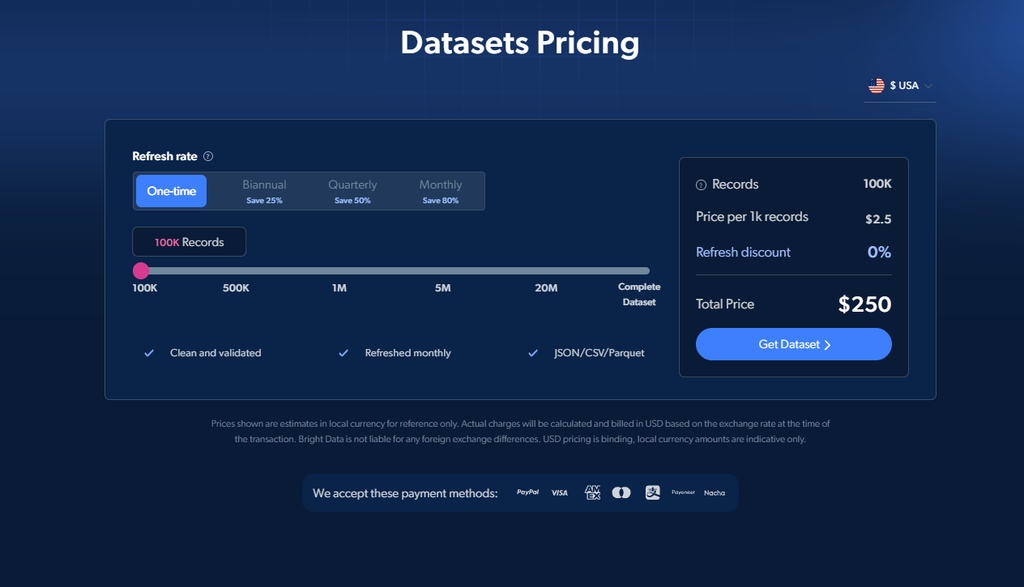
Bright Data pricing starts free: 5,000 credits a month, shared across the Unlocker API, SERP API, Web Scraper API, Scraper Studio and Browser API, with no card required (free tier docs). Proxies aren't part of that pool. After the free credits, each product has its own pay-as-you-go rate and its own $499 Scale plan.
| Product | Billed per | Pay as you go | Scale plan | Effective Scale rate |
|---|---|---|---|---|
| Unlocker API | 1,000 successful requests | $1.50 | $499/mo, 383K requests | $1.30 per 1K |
| SERP API | 1,000 successful requests | $1.50 | $499/mo, 380K requests | $1.31 per 1K |
| Web Scraper API | 1,000 records | $1.50 | $499/mo, 384K records | $1.30 per 1K |
| Browser API | GB of traffic | $8.00/GB | $499/mo, 71 GB | $7.03/GB |
| Residential proxies | GB | $8.00/GB list, $4.00 with the current 50% promo | $499/mo, 141 GB on the promo | $3.54/GB (promo code RESIGB50, 3 months) |
| Datacenter proxies | GB (or per IP) | $0.60/GB | $499/mo, 1 TB | $0.51/GB as list |
Two things most comparison posts get wrong. First, there's no $499 minimum anymore: the Unlocker pricing page shows a free tier, pay-as-you-go and "cancel anytime". Second, the "starts from" prices in Bright Data's menus (for example $5/GB for the Browser API) are lower than its own pricing tables. Budget from the tables.
Bottom line: Bright Data is cheap to start now. It's the flat $1.50 on every easy page that adds up later.
Bright Data scraping browser pricing
The Browser API (formerly Scraping Browser) bills per GB of traffic, with no per-request fee: $8/GB on pay-as-you-go, $499 for 71 GB on Scale, and 1 GB free each month. Concurrent sessions are unlimited.
That makes page weight your real price. Say a page pulls 2 MB through the browser (a hypothetical figure; real pages vary a lot). That's about 512 pages per GB, or roughly $15.63 per 1,000 pages at pay-as-you-go. Halve the weight and you halve the bill, so skip images, fonts and video wherever your script can.
Bright Data reviews: what users actually say
The scores are strong across all three big platforms.
| Platform | Score | Reviews |
|---|---|---|
| G2 | 4.7 / 5 | 349 |
| Capterra | 4.7 / 5 | 68 |
| Trustpilot | 4.3 / 5 | 1,036 |
Ratings checked November 2026.
The tags tell you more than the averages. On G2, customer support (51 mentions) and ease of use (45) lead the positives, while limitations (13), pricing issues (8), expensive (8) and learning difficulty (8) lead the negatives. Capterra users rate value for money 4.3, Bright Data's lowest subscore there. On Trustpilot, 85% of reviews are five stars and 9% are one star, and recent complaints mention an AI support bot, slow replies and rejected KYC checks.
So: people like the network and the humans behind it. They grumble about price and complexity. Sound familiar?
Easy pages vs hard pages: the math that decides whether you save
Here's the formula we used for every tool:
Cost per 1,000 pages = plan price ÷ plan credits × credits per request × 1,000
Bright Data skips the middle of that formula. One successful request costs the same no matter what it took to fetch. Credit-based APIs, ours included, charge more for harder pages. So the honest comparison has four rows, not one.
| Page type | Web-Scraper-API credits | Web-Scraper-API Starter ($49 / 600K) | Web-Scraper-API pay as you go ($0.150 per 1K credits) |
|---|---|---|---|
| Static, standard proxy | 3 | $0.25 | $0.45 |
| JavaScript, standard proxy | 7 | $0.57 | $1.05 |
| Static, residential proxy | 13 | $1.06 | $1.95 |
| JavaScript, residential proxy | 17 | $1.39 | $2.55 |
Read the last row twice. On our pay-as-you-go credits, a JavaScript page through residential IPs costs more than on Bright Data. On a monthly plan it costs a little less, and on Pro ($299 for 5M credits) it drops to about $1.02.
Now a hypothetical month. You scrape 100,000 pages: 70% static, 20% need JavaScript, 10% are protected and need residential IPs.
- Web-Scraper-API: (70,000 × 3) + (20,000 × 7) + (10,000 × 17) = 520,000 credits. That fits the $49 Starter plan.
- Bright Data: 100,000 × $1.50 ÷ 1,000 = $150 on pay-as-you-go.
Make all 100,000 pages hard and the gap nearly closes: 1.7M credits fits our $129 Growth plan, against $150 on Bright Data.
Bottom line: the share of hard pages decides whether you save, not the headline rate. Sort a sample of your URLs before you pick anything.
How we judged these alternatives
Every tool got the same six checks. Cost per 1,000 protected JavaScript pages. Cost per 1,000 static pages. Free tier and commitment. Signup friction. Billing fairness (failed requests, expiry). Evidence and team fit: a named benchmark, SOC 2 or ISO, an MCP server.
We didn't run a benchmark for this post, and no independent test we know of puts Web-Scraper-API next to Bright Data. Where a named benchmark exists, we cite it.
The 9 best Bright Data alternatives in 2026
1. Web-Scraper-API: Best for mixed workloads on a small budget
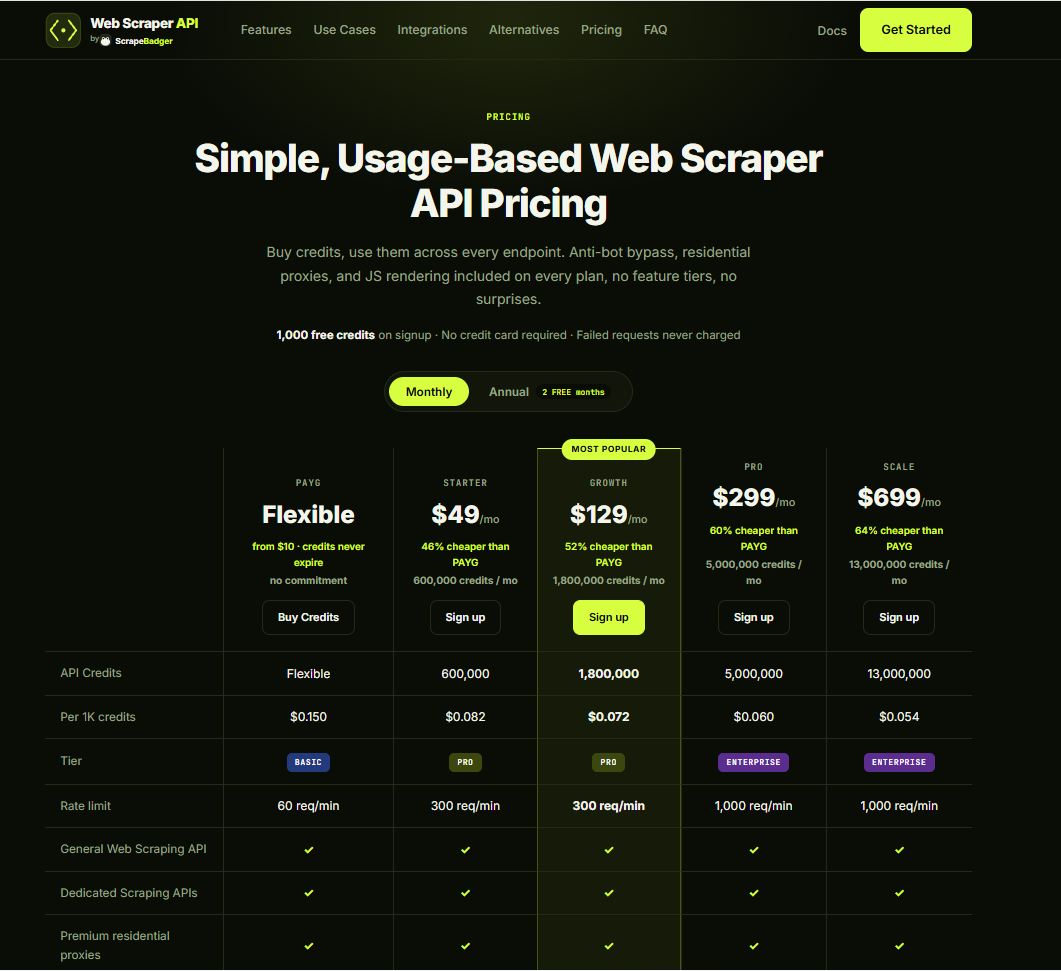
Web-Scraper-API is our web scraping API, powered by ScrapeBadger. One endpoint picks the engine (plain HTTP or a real browser) and the proxy tier per request, so easy pages stay cheap and hard pages get the heavy treatment.
- Anti-bot handling for Cloudflare, DataDome, Akamai, Imperva, PerimeterX (HUMAN) and Kasada
- Residential proxies in 150+ countries
- Escalation that bills only the method that succeeds, plus a
max_costcap per request - HTML, Markdown, plain text or screenshot output; SDKs including Python and Node
- A hosted MCP server with 300+ tools across 30+ products
Pricing: 1,000 free credits, no card. Pay-as-you-go from $10 at $0.150 per 1,000 credits, and those credits never expire. Monthly plans: Starter $49 (600K credits), Growth $129 (1.8M), Pro $299 (5M), Scale $699 (13M). Failed requests cost 0 credits. Full table on our pricing page.
Pros
- Static pages cost about a sixth of Bright Data's rate ($0.25 vs $1.50 per 1,000)
- Pay-as-you-go credits never expire, so a $10 top-up can last months
- Blocks, timeouts and empty responses are free
Cons
- Residential plus JavaScript on pay-as-you-go ($2.55 per 1,000) costs more than Bright Data's $1.50
- No SOC 2 report; Bright Data, Oxylabs, Apify, Firecrawl and Scrapfly all have one
- No crawl endpoint and no dataset marketplace
- No independent benchmark includes us yet, and our review base is still small
Try it on your own URLs. 1,000 free credits cover about 58 protected JavaScript pages, enough for a real side-by-side. Start free, no card needed.
2. Oxylabs: Best like-for-like replacement
Want to swap Bright Data out piece by piece? Oxylabs is the closest match. It sells residential proxies, a Web Scraper API, a Web Unblocker, an Agent Browser and datasets, and since October 2026 one shared credit balance covers all of them.
- JavaScript-rendered results from $1.50 per 1,000 on Starter ($1.30 on Flexible, $1.22 on Enterprise); the generic /Scrape endpoint starts at $0.50; residential proxies run $6/GB down to $2.50/GB above 1,000 GB
- SOC 2 Type 2, SOC 3 and ISO 27001 (trust center), plus official MCP servers
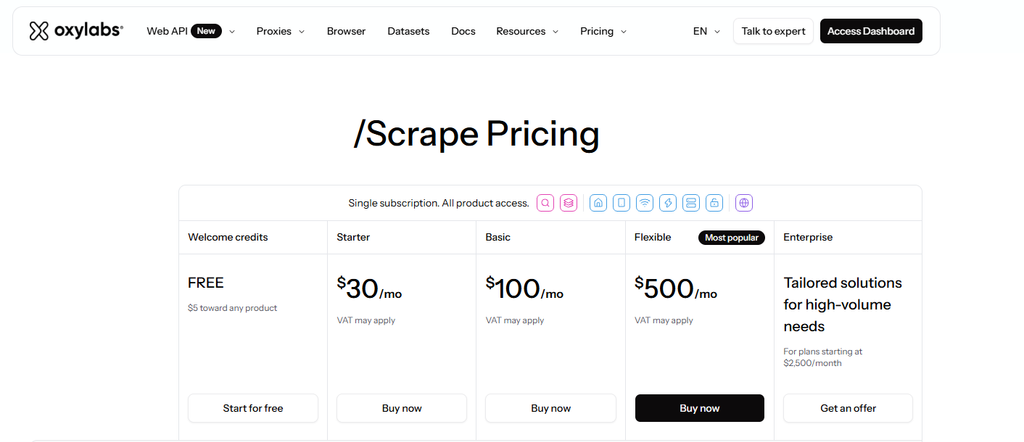
Pricing: a $5 welcome credit, no payment details. Then Starter $30/mo, Basic $100, Flexible $500, Enterprise from $2,500 (pricing).
Pros: the same product shape as Bright Data; the same $1.50 hard-page price from a $30 entry; enterprise paperwork in place.
Cons: 4xx responses are billed as well as 2xx; no pay-as-you-go.
Ratings: G2 4.5 (421), Capterra 4.7 (23), Trustpilot 3.9 (773).
3. Decodo: Best for cheap residential bandwidth
Decodo (formerly Smartproxy) is the value pick when proxies are most of your bill. Its Web Data API also has /crawl and /map endpoints, which is more than we offer.
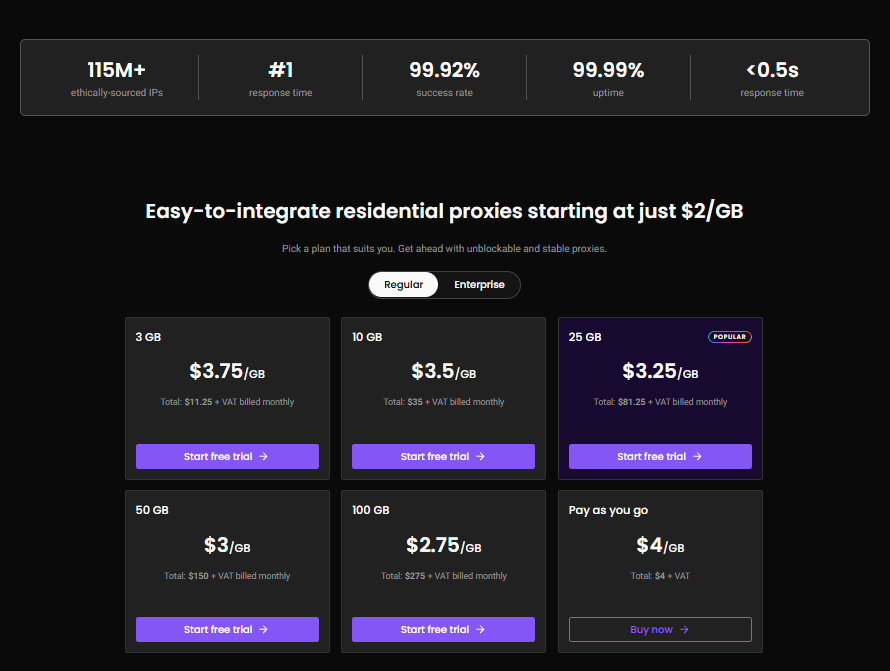
- Residential at $4/GB pay-as-you-go, about $2/GB at 1,000 GB (pricing)
- Premium proxy plus JavaScript at $1.50 per 1,000 on the $19 plan, $0.85 at $1,499 (billing)
- A Site Unblocker at $0.95 per 1,000
- ISO 27001 and an official MCP server
Pricing: a $5 credit with no card, then plans from $19/mo with a 14-day money-back guarantee. You only pay for successful requests.
Pros: some of the cheapest bandwidth here; a hard-page rate equal to Bright Data's; crawl built in.
Cons: API plans auto-renew and there's no pay-as-you-go; no SOC 2; no hosted browser listed.
Ratings: G2 4.6 (782), Trustpilot 4.2 (2,111).
4. Zyte: Best for the hardest targets (if tier pricing doesn't scare you)
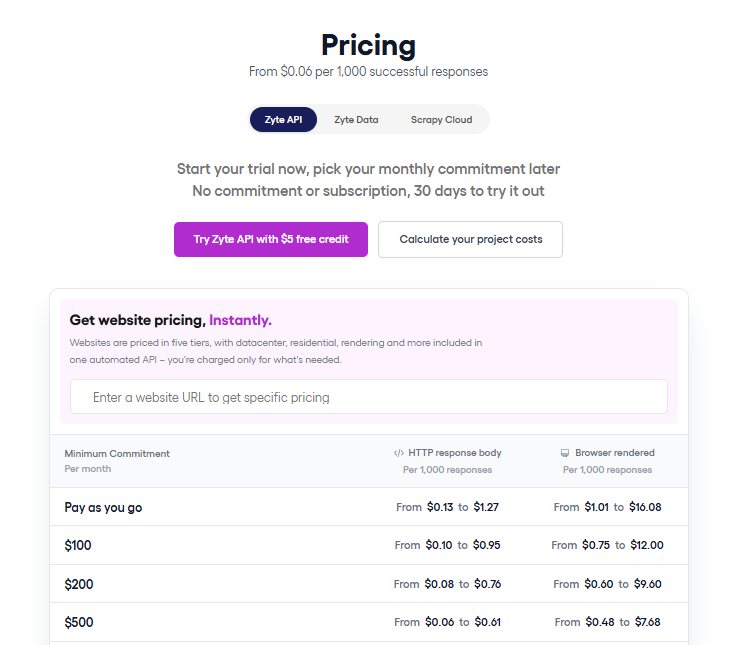
Zyte opened protected targets more often than any of the 11 APIs in Proxyway's 2025 scraping API report, tested across 15 targets in October 2025. The catch? Bright Data wasn't in that test. And Zyte prices each site by difficulty, then picks the tier for you.
- HTTP requests from $0.13 per 1,000 on the easiest tier
- Browser requests from $1.01 (tier 1) to $16.08 (tier 5) per 1,000 on pay-as-you-go (pricing), 25-52% less with a $100-$500 commitment
- CDP browser support since 1 September 2026, ISO 27001, and a free MCP server
Pricing: a $5 credit for the first month, then pay-as-you-go with a spending limit. A "complex" browser site (tier 4) costs $8.04 per 1,000, or $6.00 on the $100 commitment. Failures are free.
Pros: the strongest published success record; very cheap on easy sites.
Cons: a hardened site can land in tier 4 or 5 and cost 4-10x Bright Data; residential network costs aren't published.
Ratings: G2 4.4 (122), Capterra 4.4 (43), Trustpilot 4.2 (28).
5. Apify: Best for replacing Bright Data's ready-made scrapers
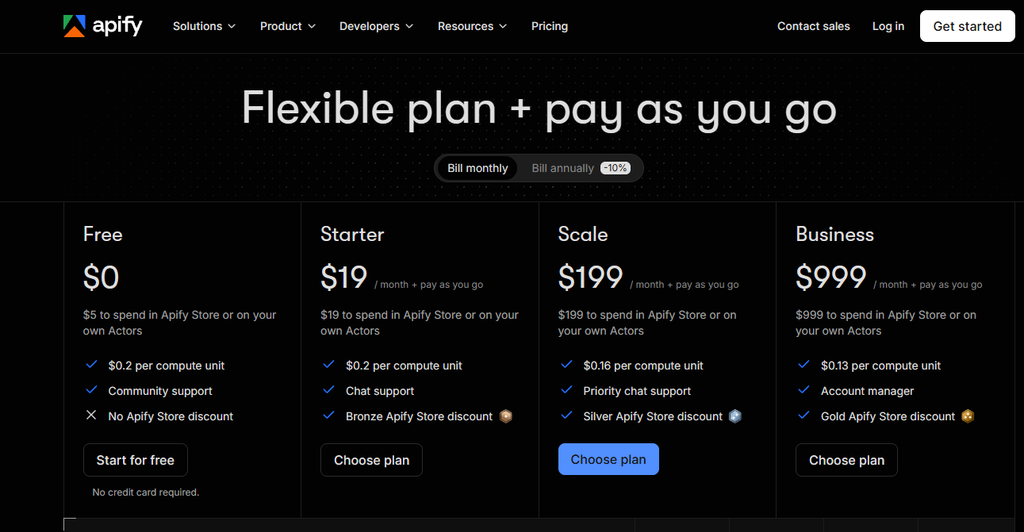
Mostly using Bright Data's per-record Web Scraper API or its datasets? Apify is the closer swap. Its Store is full of ready-made scrapers ("Actors") that run on Apify's cloud, with schedules and dataset exports.
- Residential proxies at $8/GB on Starter, $7.50/GB on Scale
- SOC 2 Type II (security) and a hosted MCP server
Pricing: $5 of free usage a month, no card. Starter is $19/mo, which buys $19 of usage at $0.20 per compute unit (1 GB of memory for one hour); Scale is $199 and Business $999 (pricing).
Pros: no scraper code to maintain for popular sites; a generous free start; strong reviews.
Cons: cost depends on each Actor's memory, run time and proxy traffic, so you won't know the per-page price until you run it. Unused usage expires each cycle, and we couldn't find a published policy on failed runs.
Ratings: G2 4.7 (687), Capterra 4.8 (610).
6. Firecrawl: Best for AI and LLM pipelines
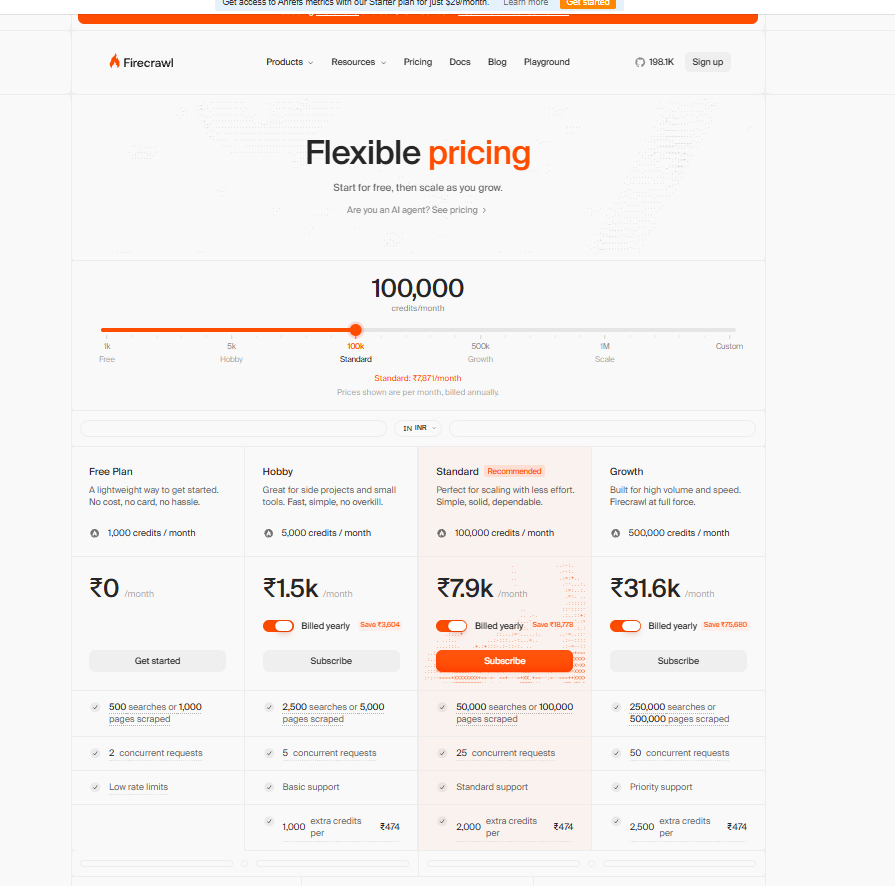
Firecrawl returns clean Markdown or JSON for language models, through Scrape, Crawl, Map, Search and Agent endpoints. Its pricing flips the multiplier model on its head: a page costs one credit, easy or hard.
- 1 credit per page with its stronger proxy mode included (docs); JSON extraction adds 4
- SOC 2 Type II on every plan, a hosted MCP server, and a $75M Series B raised on 22 September 2026
Pricing: 1,000 free credits a month. Hobby is $19/mo for 5,000 credits, so $3.80 per 1,000 pages (pricing). No result, no charge, though 403 and 404 responses cost a credit.
Pros: LLM-ready output with no parsing; a flat price on hard pages; crawling included.
Cons: $3.80 per 1,000 is 2.5x Bright Data's rate on every page, easy pages included; no rollover on lower plans.
Ratings: G2 4.6 (398).
7. Scrapfly: Best for a cloud browser with compliance paperwork
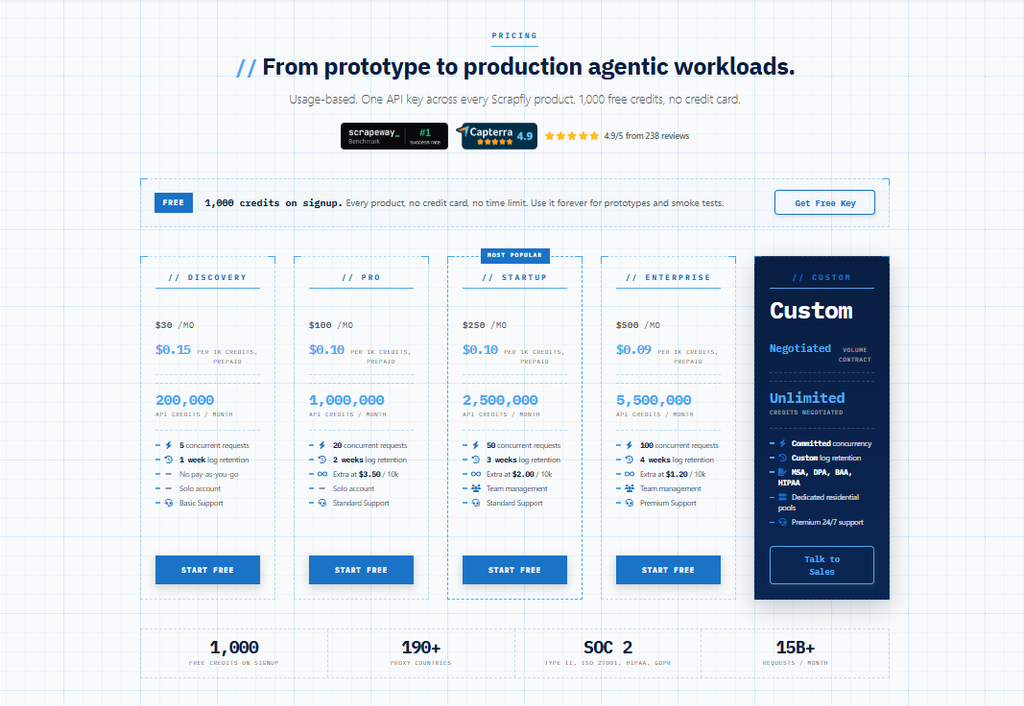
Scrapfly puts a scraping API (with its Unblocker, formerly ASP), a Cloud Browser, a Crawler, a Screenshot API and an Extraction API on one credit pool.
- 1 credit per datacenter request, 6 with rendering, 25 residential, 30 residential plus rendering (billing)
- SOC 2 Type II, ISO 27001, HIPAA on custom plans, and a GDPR DPA on paid plans
- An open-source MCP server
- Failed scrapes (mainly 5xx, 403 and 429) aren't billed, though 400, 401, 404, 410 and other 4xx codes are
Pricing: 1,000 free credits, then Discovery at $30/mo for 200,000 credits. That makes a residential page with rendering $4.50 per 1,000, before the Unblocker moves anything to a pricier pool mid-request. Our Scrapfly alternative page has the rest.
Pros: SOC 2, ISO 27001 and HIPAA in one place; static requests at $0.15 per 1,000; browser, crawler and extraction on one bill.
Cons: hard pages cost 3x Bright Data on the entry plan, and the Unblocker makes costs hard to predict.
Ratings: G2 4.7 (115), Capterra 4.9 (238).
8. ZenRows: Best for testing on a free monthly allowance
ZenRows hands every account 5,000 free credits a month. Its Universal Scraper API is now called Fetch and sits next to Extract, Crawl, Batch and Browser.
Pricing: 1 credit standard, 5 with JavaScript, 10 with premium proxies, 25 for both (pricing docs). Build B1 is $19/mo for 45,000 credits, so a protected JavaScript page costs $19 ÷ 45,000 × 25 × 1,000 = $10.56 per 1,000, or $3.33 on the $399 plan. Failed requests are free; 404 and 410 responses aren't.
Pros: a free allowance that renews monthly; easy pages at $0.42 per 1,000; an MCP server on every plan.
Cons: hard pages cost about 7x Bright Data on the entry plan; plan credits expire at every renewal.
Ratings: G2 5.0 (18), Capterra 4.7 (103).
9. ScraperAPI: Best for the simplest possible integration
ScraperAPI is the "send a URL, get HTML" option, and it's on almost every Bright Data alternatives list. It's also the priciest of these nine on protected pages. You should know both.
- One endpoint plus domain endpoints for Amazon, Google and others
- Premium plus rendering at 25 credits, ultra-premium plus rendering at 75 (credit costs)
- Announced its acquisition of Traject Data (SerpWow, Rainforest API) in April 2026
Pricing: a 7-day trial with 5,000 credits, then Hobby at $49/mo for 100,000 credits, with geotargeting limited to the US and EU. A protected JavaScript page costs $49 ÷ 100,000 × 25 × 1,000 = $12.25 per 1,000. More on our ScraperAPI alternative page.
Pros: one parameter-driven endpoint that takes minutes to wire up; static pages at $0.49 per 1,000; an official MCP server.
Cons: hard pages cost about 8x Bright Data; 404s and cancelled requests are billed.
Ratings: G2 4.3 (15), Capterra 4.6 (62), Trustpilot 4.5 (42).
Also considered
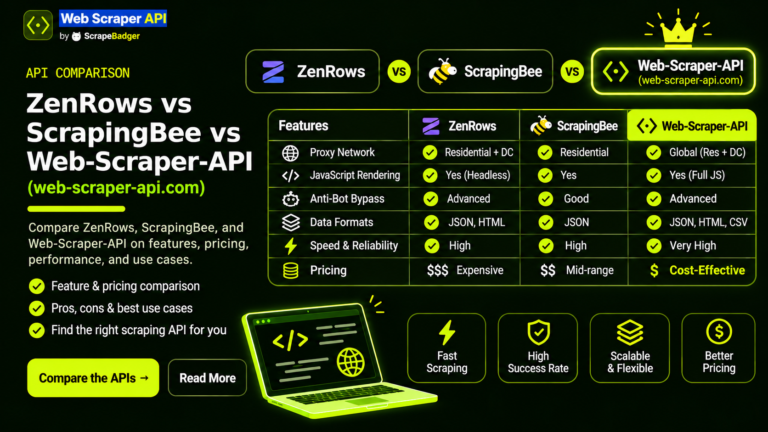
ScrapingBee charges 25 credits for premium proxies with JavaScript, so its $19 Hobby plan (75,000 credits) works out to $6.33 per 1,000 hard pages. It's now part of Oxylabs Group (our ScrapingBee comparison). Scrapingdog's $40 Lite plan comes to $5.00 per 1,000 hard pages (our Scrapingdog comparison). SOAX sells residential and mobile proxies at $2-$5/GB on its no-subscription Sandbox tier, but its SOC 2 and ISO certifications are still in progress. Every other option is on our alternatives hub
Web-Scraper-API vs Bright Data side by side
| Web-Scraper-API | Bright Data | |
|---|---|---|
| Free start | 1,000 credits, no card | 5,000 credits/mo shared across APIs, no card |
| Pay as you go | From $10, credits never expire | $1.50 per 1,000 successful requests |
| Smallest monthly plan | $49 (600K credits) | $499 Scale (383K Unlocker requests) |
| Static page, per 1,000 | $0.25 (Starter) | $1.50 (pay as you go) |
| Protected JS page, per 1,000 | $1.39 (Starter), $2.55 (pay as you go) | $1.50 (pay as you go) |
| Failed requests | Free | Free unless custom headers, cookies or expect are on |
| Residential signup | Included in every plan | KYC with company documents for new zones |
| Crawling and datasets | Neither | Crawl API and dataset marketplace |
| Compliance | No SOC 2 report | SOC 2 Type II, ISO 27001/27017/27018 |
How to migrate from Bright Data
Most Bright Data code is a single POST to the Unlocker API. Moving it is mostly a find-and-replace.
Before (Bright Data Unlocker API, from its docs):
curl https://api.brightdata.com/request \ -H "Content-Type: application/json" \ -H "Authorization: Bearer $BRIGHTDATA_API_KEY" \ -d '{"zone": "your_unlocker_zone", "url": "https://example.com", "format": "raw"}'After (Web-Scraper-API):
curl https://scrapebadger.com/v1/web/scrape \
  -H "Content-Type: application/json" \
  -H "x-api-key: $SCRAPEBADGER_API_KEY" \
-d '{"url": "https://example.com", "format": "html", "render_js": true, "country": "us"}'| Bright Data | Web-Scraper-API | Note |
|---|---|---|
Authorization: Bearer <key> | x-api-key: <key> | Key from your dashboard |
zone | (none) | Engine and proxy are chosen per request |
url | url | Same |
format: "raw" | format: "html" | Markdown and text also available |
render: "true" | render_js: true | Or let escalation decide |
| Raw page body | JSON with content and credits_used | You see the cost of every call |
Then run both for a week on the same URL sample. Compare success on the pages you care about and the credits_used total against Bright Data's usage dashboard. One honest warning: Bright Data's crawl jobs and dataset orders don't have an equivalent here, so leave those where they are. Python users can start from our Python guide.
When to stay with Bright Data
Switching isn't always the smart move. Stay if:
- Almost all your targets are hardened. At $1.30 per 1,000 on Scale, Bright Data's flat rate beats most alternatives on protected pages.
- You buy datasets or per-record scrapers across many sites. Nothing on this list matches that catalog.
- Procurement needs SOC 2 Type II and ISO certificates. Bright Data has both on file (the SOC 2 report under NDA).
- You track deep Google rankings. Bright Data returns the top 100 results as one billable request, which we can't match (more in our Google SERP API comparison).
FAQ
What is the best alternative to Bright Data?
It depends on what you use Bright Data for. Web-Scraper-API costs the least for a mix of easy and hard pages on a small budget. Oxylabs is the like-for-like stack with SOC 2. Need cheap residential bandwidth? Decodo. Ready-made scrapers? Apify.
What is a cheaper alternative to Bright Data?
On static pages, almost any credit-based API: Web-Scraper-API runs $0.25 per 1,000 on Starter against Bright Data's $1.50. On protected JavaScript pages, only Oxylabs, Decodo and our monthly plans come in at or under its $1.50 pay-as-you-go rate.
Is there a free alternative to Bright Data?
Not at scale. ZenRows (5,000 credits), Firecrawl (1,000) and Apify ($5 of usage) renew monthly, we give 1,000 credits once, and Bright Data now gives 5,000 a month.
Is Bright Data worth it?
Yes, if most of your targets are hard, you need its datasets, or your security team wants SOC 2 Type II. It's worth a lot less when most of your pages are static, because you pay $1.50 per 1,000 for pages other tools fetch for a fraction of that. With 4.7 on both G2 and Capterra, the product isn't the issue. The pricing model is.
Who are Bright Data's competitors?
Oxylabs and Decodo, which sell the same mix of proxies and scraping APIs. Zyte competes on hard targets, Apify on ready-made scrapers and Firecrawl on AI-ready output. Web-Scraper-API, Scrapfly, ZenRows and ScraperAPI compete with the Unlocker API.
Can I migrate from Bright Data without rewriting my scraper?
Usually, yes. Your parsing code stays put. Swap the endpoint, move the key into an x-api-key header, drop zone, map render to render_js, and run both side by side for a week.
The short version
Bright Data charges the hard-page price for every page. If most of your pages aren't hard, you're overpaying, and almost any tool here will save you money. If they are, the savings shrink to a few cents, so the deciding factors become commitment size, signup friction and paperwork.
Pull 50 of your hardest URLs, run them on two free tiers, and let the logs decide. Start with 1,000 free credits, no card needed.
Related reading